How accurate is an astrology birth chart?
Kevin Blaxton · 6 min read ·
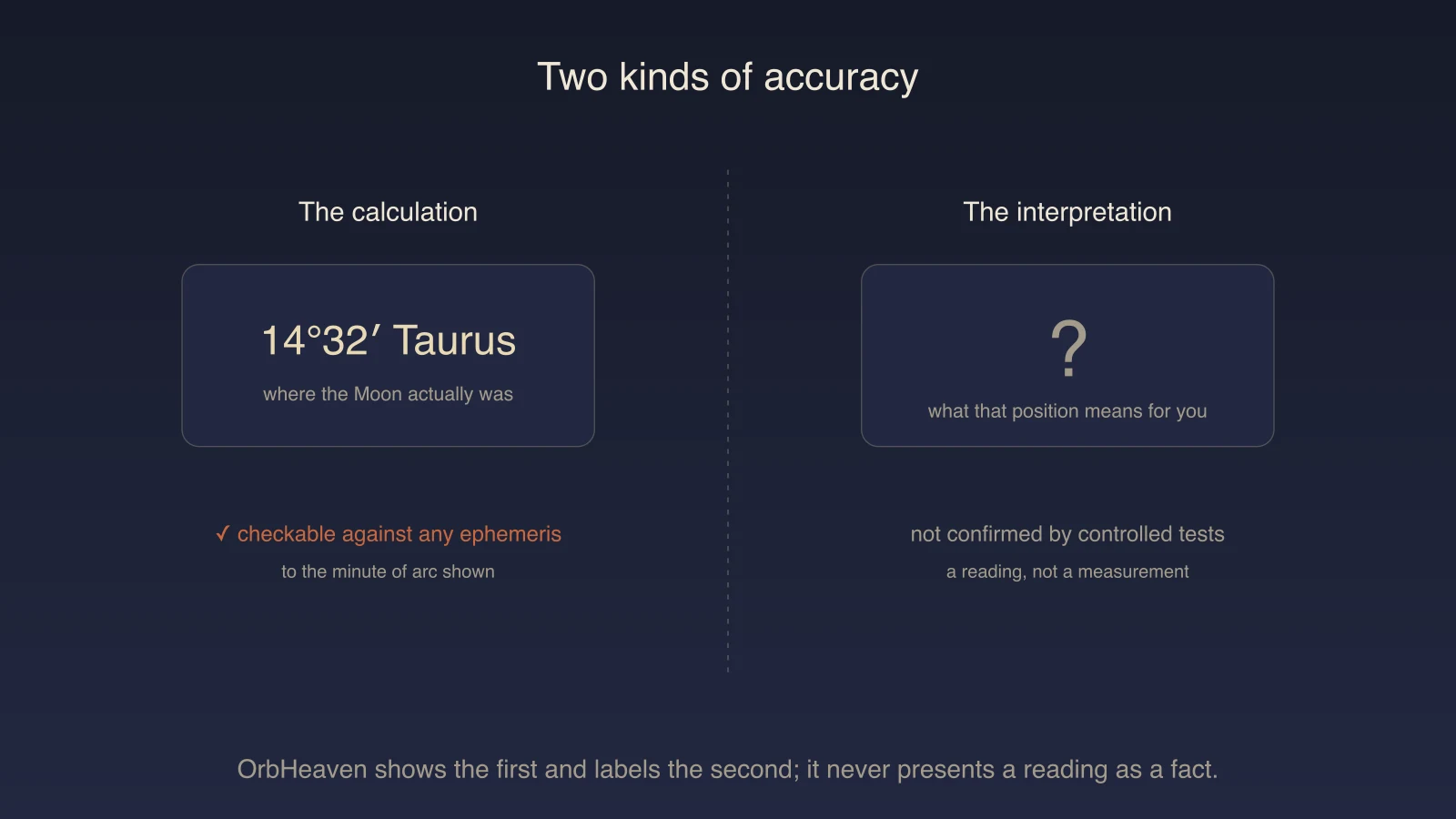
Two different things get called a birth chart’s accuracy, and they have opposite answers. The astronomy is accurate: the Sun, Moon and planets are placed where they actually were, agreeing with any published ephemeris to well within the minute of arc the chart shows, and you can check it. Whether the chart’s meaning is accurate is a separate question, and the honest answer is that it is not established — controlled tests have not found the effects astrologers describe. A chart can still be wrong, but almost always because the birth details were wrong, not because the arithmetic was.
Is the calculation accurate?
Yes, and this is the checkable half. OrbHeaven computes every position from a published astronomical engine, on the tropical zodiac with Placidus houses, for the exact universal time of birth; the planets agree with any other ephemeris to well within the minute of arc shown. The engine, its version, the zodiac, the node and the house system are printed under every chart, so the arithmetic can be checked against an outside source. See how it works for the method in full.
What makes a birth chart wrong, then?
Usually the birth data, not the calculation. The birth time matters most: the rising degree moves about fifteen degrees an hour on average, so an hour’s error can change the rising sign and shift every house. The time zone matters too — daylight-saving and historical clock rules decide how a local birth time becomes universal time — and so does the birthplace. Rounding a position to the displayed degree and minute is the smallest difference of all. See why two calculators disagree.
Do you need an exact birth time?
For the rising sign, the houses and a precise Moon, yes; for the rest, less than you would think. The Sun and the planets barely move in an hour, so a chart from the date alone still places them. The Ascendant and the houses need the time, and OrbHeaven leaves them out rather than guess one. See your rising sign and without a birth time.
Is the interpretation accurate?
This is the half with no established answer. Calculating where the planets were is checkable; what their positions mean for a person is not, and controlled studies have not found the effects astrologers describe. The best known is a double-blind test published in the journal Nature in 1985, in which astrologers matching birth charts to personality profiles did no better than chance. OrbHeaven treats astrology as a framework for reflection rather than a method of prediction, and labels every reading as interpretation, not fact.
Where this is disputed
Even that study is argued over: the psychologist Hans Eysenck and later re-analyses held that its own data did not clearly support the sceptical conclusion, while most scientists read the wider evidence as finding no effect. What is not in dispute is that there is no accepted mechanism and no repeated, controlled demonstration of the claims.
OrbHeaven calculates your chart from a published ephemeris and shows the working — the engine, the zodiac, the house system and the exact universal time under every chart — and says plainly which parts are measured and which are read. Draw your free birth chart; it costs nothing and keeps nothing. How it works sets out the method.
About a minute. Birth time optional, and no account until after you have seen it.
Terms used here
Read next
Which five planets are in retrograde in October 2026, and what does it mean?
Venus, Saturn, Uranus, Neptune and Pluto are all retrograde together from 3 October 2026 until Pluto turns direct late on 15 October (Eastern) / 16 October (UTC). Here is what retrograde actually means, why so many overlap, and what the tradition reads into it.
What are chart patterns in astrology?
A chart pattern is a shape several planets make — a grand trine, T-square, grand cross, yod or kite. Here is what each one is, drawn from a real chart.
Moon sign vs Sun sign: what’s the difference?
Your Sun sign comes from your date; your Moon sign changes every couple of days, so it often needs your birth time. Here is the difference, why the Moon sign is harder to pin down, and why both are signs, not constellations.
Written by Kevin Blaxton for OrbHeaven. About