Why do astrology calculators give different results?
Kevin Blaxton · 10 min read ·
Usually because they made different choices, not because one of them calculated the sky incorrectly. Modern ephemerides agree on the planets to well within the minute shown. Most differences come from conventions and inputs: the house system, the zodiac, the mean or true node, how a local birth time was converted to universal time, what is done without a birth time, which aspects and orbs are counted, and how degrees are rounded. The birth time matters most, because at mid-northern latitudes the rising sign can change in well under an hour. Compare the settings first, then the numbers.
Is a different result a wrong result?
Not necessarily. Differences between calculators fall into three kinds. Some are conventions with no single right answer, such as the house system, the zodiac, the node, the orbs and the rounding. Some are inputs, such as the birth time and the coordinates of the birthplace. Other differences involve facts that can be checked against an outside record, such as where the planets were and which clock rules applied at a place on a date. Work out which kind you are looking at before deciding anything.
Calculated: every example on this page is run through one engine, the same one behind OrbHeaven’s charts, changing a single setting at a time. Where two results differ here, the only thing that changed is the setting, which is the point: the same software gives different answers when it is asked a different question.
Even the checkable facts have limits. Planetary positions are checked against published ephemerides. Clock rules come from the international time zone database, whose records are strongest from 1970 onward; earlier records can be less certain, particularly where local clocks differed from a region’s recorded standard. Following the published record is not the same as being certain.
Do calculators disagree about where the planets are?
Rarely by much, and usually for a reason that can be named. Modern ephemerides agree on the planets to well within the minute shown. Visible differences in planetary positions mostly come from choices: measuring from the centre of the Earth or from the birthplace, measuring against the ecliptic of the birth date or a fixed reference year, using the mean or the true lunar node, and how a degree is rounded for display. Each is small, but some cross a sign or degree boundary.
Calculated: seen from the birthplace rather than the centre of the Earth, the Moon shifts because it is close enough for the viewpoint to matter. In the example chart, J2000.0 (noon UTC on 1 January 2000 at Greenwich), that shift is 0.24°; at Greenwich during 2000 it reached 0.88°. Measuring against the fixed ecliptic of the year 2000 instead of the ecliptic of the date moves every position by the slow drift of the equinox, about 0.37° for a date in 2026. The true node, which follows the Moon’s actual path, can sit up to 1.98° from the averaged mean node (the largest gap between 1900 and 2100, by the Swiss Ephemeris).
Rounding is the smallest difference and the most common. In the example chart, Saturn is at 10 degrees and 23.77 minutes of Taurus. Shown rounded down, that is 10°23′ Taurus; rounded to the nearest minute, 10°24′. Neither is an error.
On your OrbHeaven chart: positions are geocentric, measured against the ecliptic of the birth date, with the mean node, and the minutes are rounded down. The line at the foot of the chart names the engine, the zodiac and the node.
Where this is disputed
Astrologers divide over the node. The mean node is the older convention and moves smoothly; the true node follows the Moon’s actual path and wobbles around it. Neither is a calculation error. See the lunar nodes.
Why do house placements change between calculators?
Because there is more than one way to divide the sky into twelve houses, and calculators default to different ones. Placidus divides by time, so its houses are usually unequal. Whole-sign houses make each house one whole sign, counted from the rising sign. Equal houses take thirty degrees each from the Ascendant. The planets stay where they are; the house lines move around them. The differences are largest for planets near a house boundary and at higher latitudes.
Calculated: in the example chart, with the Ascendant at 24°15′ Aries, the same planets fall like this. The Sun is in the 10th house under Placidus and whole-sign houses, but the 9th under equal houses. The Moon is in the 7th under Placidus and equal houses, but the 8th under whole-sign. Mars is in the 12th under Placidus, but the 11th under both of the others. Saturn is in the 1st under Placidus and equal houses, but the 2nd under whole-sign.
On your OrbHeaven chart: houses are Placidus, named next to the Placements heading. Where Placidus cannot be calculated, very far north or south, the chart switches to whole-sign houses and says so.
Where this is disputed
There is no agreed answer to which house system is right. Whole-sign is the oldest, Placidus has been the most common modern default, and many astrologers choose by tradition or by what they find useful. See house systems.
The example chart, three house systems
| Planet | Placidus | Whole-sign | Equal |
|---|---|---|---|
| Sun | 10th | 10th | 9th (differs from Placidus) |
| Moon | 7th | 8th (differs from Placidus) | 7th |
| Mercury | 9th | 10th (differs from Placidus) | 9th |
| Venus | 8th | 9th (differs from Placidus) | 8th |
| Mars | 12th | 11th (differs from Placidus) | 11th (differs from Placidus) |
| Jupiter | 1st | 1st | 1st |
| Saturn | 1st | 2nd (differs from Placidus) | 1st |
| Uranus | 11th | 11th | 10th (differs from Placidus) |
| Neptune | 11th | 11th | 10th (differs from Placidus) |
| Pluto | 8th | 9th (differs from Placidus) | 8th |
Ascendant 24°15′ Aries · calculated with astronomy-engine 2.1.19 · bold where a system differs from Placidus
How much does the birth time move the Ascendant?
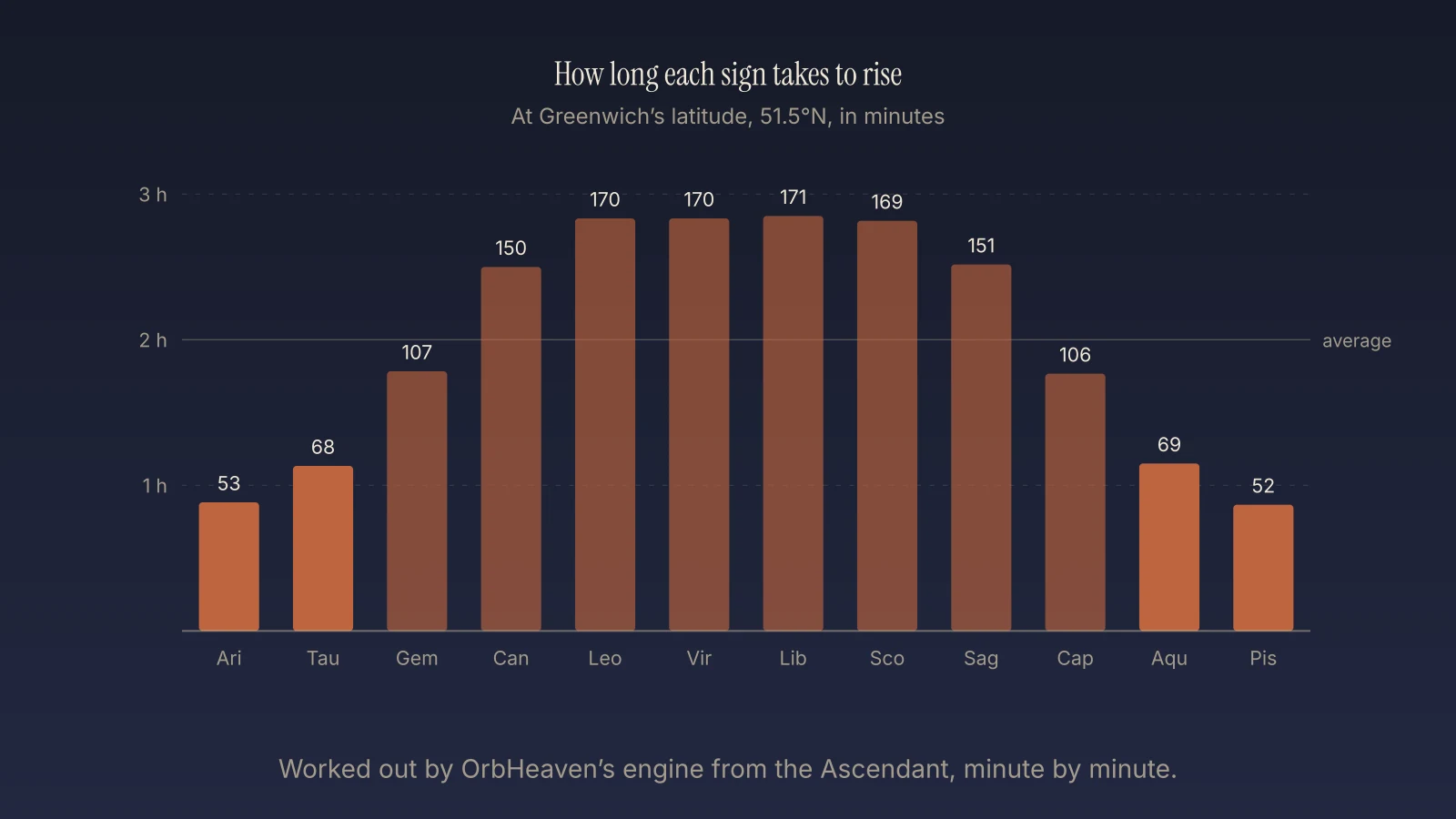
A great deal, and unevenly. The rising sign changes about every two hours on average, but some signs rise in under an hour and others take nearly three, depending on latitude. So a few minutes can move the Ascendant by a degree or more, and an hour can change the rising sign entirely. Because the houses are counted from the Ascendant, every house line moves with it. A rounded or remembered birth time is the commonest input difference between two charts.
Calculated: at Greenwich’s latitude, the time each sign spends rising ranges from 52 minutes for Pisces to 171 minutes for Libra. In the example chart, the Ascendant is 24°15′ Aries at noon. At 12:04 it is 26°26′ Aries, at 12:11 it enters Taurus, and one hour earlier, at 11:00, it was 19°05′ Pisces.
On your OrbHeaven chart: the Ascendant is given to the minute of arc, and the exact universal time the chart was cast for is printed at the foot, so you can see exactly which moment was used.
How can time zones and daylight saving change a chart?
A chart is calculated for a moment in universal time, so a local clock time has to be converted using the rules that applied at that place on that date. Those rules have changed often. If a calculator applies the wrong offset, even by one hour, the planets barely move but the Ascendant and houses can shift a long way. Clock times that happened twice, when clocks went back, or never happened, when clocks went forward, need a decision rather than a guess.
Calculated: Indianapolis did not observe daylight saving in 1985. A birth there at 09:15 on 15 July 1985, converted with the rules in force, gives an Ascendant of 6°49′ Virgo; converted as if daylight saving applied, it gives 24°54′ Leo, a different rising sign. In January 1974 the United States was on year-round daylight saving, so a birth in Chicago at 03:00 on 15 January 1974 gives 14°13′ Scorpio, against 25°54′ Scorpio if standard time is assumed: the same sign, with the Ascendant moved by 11°41′ and the house lines moving with it.
Calculated: in New York, 01:30 on 2 November 2025 happened twice, an hour apart. The two readings give Ascendants of 28°35′ Leo and 10°25′ Virgo. 02:30 on 9 March 2025 never happened there at all.
On your OrbHeaven chart: the birth time is converted with the historical time-zone rules for that place and date. A time the clocks repeated is asked about, with both readings named, and a time the clocks skipped is refused with the reason, rather than moved.
What happens when the birth time is unknown?
Calculators handle it in different ways, and each way is a convention. Some cast the chart for noon. Some use sunrise. Others work out what holds across the whole birth date and show ranges. A noon or sunrise chart gives a full set of houses and a rising sign, but they belong to the assumed time, not the birth. The Moon moves most in a day, so its position differs most between these approaches, and occasionally its sign.
Calculated: for 1 January 2000 at Greenwich, a noon chart puts the Moon at 13°19′ Scorpio and a sunrise chart, at about 08:06 UTC, puts it at 11°21′ Scorpio. Worked out across the whole date, the Moon covered 7–19° Scorpio. A noon chart would also show Aries rising, which comes entirely from the assumed time.
On your OrbHeaven chart: without a birth time the chart is worked out across the whole birth date. Each planet shows the degrees it covered that day, or both signs if it changed sign; aspects are marked certain or possible; and no Ascendant, Midheaven or houses are shown. See without a birth time.
Where this is disputed
Astrologers disagree about which convention is most useful. A noon chart is simple and complete-looking; a sunrise chart has its own tradition; a range shows only what the date alone can support. Each is a choice, and a chart should say which it made.
Why do some calculators put your planets in different signs?
Because some use the tropical zodiac and some the sidereal. The tropical zodiac, standard in most Western astrology, is counted from the March equinox. The sidereal zodiac, used in the Indian tradition, is measured against the stars. The two have drifted apart over centuries, so the same position can fall in different signs. The size of the gap depends on which sidereal system is used, because each fixes its starting point differently.
Calculated: on 1 July 2026 the common sidereal systems put the gap between about 22.8 and 25.1 degrees, by the Swiss Ephemeris: Raman 22.78°, Yukteshwar 22.85°, Krishnamurti 24.13°, Lahiri 24.23° and Fagan/Bradley 25.11°. That is about 22 to 25 degrees, depending on which sidereal system you ask, so most positions move back one sign.
On your OrbHeaven chart: the zodiac is tropical, named at the foot of the chart. There is more in why your star sign is not where the stars are.
Where this is disputed
Neither zodiac is a calculation error; they measure from different starting points, and each has its own long tradition. See the tropical zodiac.
Why do two charts list different aspects?
Because the angle between two planets is measured, but how close to exact it must be to count is a convention. That allowance is the orb, and calculators set it differently: wider for some aspects than others, and often wider when the Sun or Moon is involved. Some calculators also count minor aspects that others leave out. Two charts for the same birth can therefore list different aspects without disagreeing about a single position.
Calculated: the example chart lists 26 aspects with OrbHeaven’s orbs. Halve every orb and 12 remain. The positions did not change at all; only the allowance did.
On your OrbHeaven chart: the orbs are 8° for conjunctions and oppositions, 7° for squares and trines, 5° for sextiles and 2.5° for quincunxes, with one degree more when the Sun or Moon is involved. Each aspect shows its orb, so you can apply a tighter allowance yourself. See orbs.
How do you compare two charts fairly?
Line up the settings before the numbers. Check that both charts use the same universal time and the same coordinates for the birthplace. Then check the zodiac, the reference frame, the house system, the node and the orbs. Allow for a minute of arc caused by display rounding. If the planetary positions still differ materially once the time, coordinates, zodiac, reference frame and other calculation conventions match, the difference is worth investigating.
- Universal time
- The same moment, after the clock time is converted.
- Coordinates
- The same latitude and longitude, not just the same town name.
- Zodiac
- Tropical or sidereal, and which sidereal system.
- Reference frame and viewpoint
- Geocentric or topocentric, ecliptic of the birth date or a fixed reference year.
- House system
- Placidus, whole-sign, equal or another.
- Node
- Mean or true.
- Orbs
- How wide, and which aspects are counted.
- Rounding
- A minute either way is display, not disagreement.
What this does not tell you: a careful comparison can show that two charts were calculated the same way. It cannot show what any position means. That part is interpretation, and it is the same whichever calculator you use.
OrbHeaven’s free birth chart prints the engine and version, the zodiac, the node, the house system and the exact universal time it used at the foot of every chart, so you can line it up against any other calculator setting by setting.
About a minute. Birth time optional, and no account until after you have seen it.
Read next
How do you read a birth chart?
A step-by-step guide to reading a birth chart: what is calculated, how the tradition reads it, and what changes without a birth time, worked through one real example chart.
What is the difference between an applying and a separating aspect?
An applying aspect is still moving toward exact; a separating one has already passed it. Which is which is arithmetic rather than opinion, and it changes how the aspect is usually read. With a worked example you can check for yourself.
Does Mercury actually move backwards?
No. Nothing reverses. Mercury only appears to loop backwards against the stars because we are watching it from a planet that is itself moving — and knowing why makes the whole thing less mysterious and more interesting.
Written by Kevin Blaxton for OrbHeaven. About