How do you calculate your Life Path number in numerology?
Kevin Blaxton · 8 min read ·
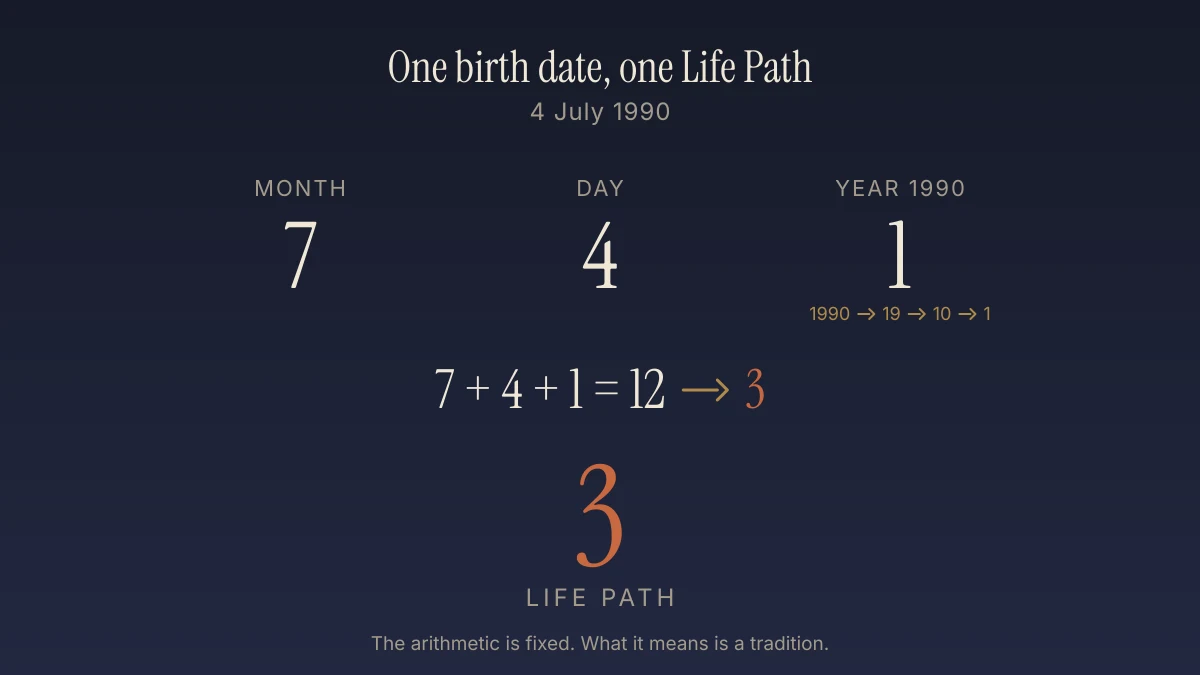
Your Life Path number is your whole birth date reduced to a single digit — unless it lands on 11, 22 or 33, the master numbers, which are kept as they are. You reduce the month, the day and the year each on their own first, then add those three results and reduce once more. Take 4 July 1990: 7 for the month, 4 for the day, and 1990 reducing to 1; add them to get 12, which reduces to a Life Path 3. Numerology is a symbolic tradition, not a measured fact about you — but the arithmetic itself is fixed and checkable.
What is numerology, and where does it come from?
Numerology is the practice of reading meaning into numbers — most often the numbers drawn from a birth date and a name. The idea that numbers carry significance is old and appears in many cultures, but the modern Western system, which maps letters to numbers one through nine, is called Pythagorean, after the Greek mathematician whose followers held that numbers underlie reality. The attribution is traditional rather than documented history.
It is worth being exact about what is and is not known. That numbers have been treated as meaningful for a very long time is a historical fact. That a particular number describes your character is an interpretive claim, part of a symbolic tradition, and not a scientifically established measurement of personality. This article keeps the arithmetic and the meaning clearly apart, because only one of them can be checked.
How do you calculate a Life Path number step by step?
Reduce each part of the birth date on its own, then add and reduce. For 4 July 1990: the month, July, is 7. The day is 4. The year 1990 reduces as 1 + 9 + 9 + 0 = 19, then 1 + 9 = 10, then 1 + 0 = 1. Now add the three results: 7 + 4 + 1 = 12. Reduce once more: 1 + 2 = 3. The Life Path is 3.
Reducing the components first is not a cosmetic choice. If a part of the date is already a master number — November is month 11, the 22nd is day 22 — reducing it too early would quietly turn an 11 into a 2, and because the components are added before the final step, that can change the Life Path itself. OrbHeaven reduces each part first for exactly this reason, and shows every line of the working so you can follow it.
What do Life Path numbers 1 to 9 traditionally mean?
Each single digit is traditionally read as a temperament. These are interpretive associations from the numerology tradition, not findings about you, and different writers phrase them differently — but the broad strokes below are the common ground, and they are a fair starting vocabulary for what each number is said to emphasise.
- 1
- Independence and initiative — the self-starter, driven to lead and to do things their own way.
- 2
- Partnership and diplomacy — the peacemaker, attuned to others and to balance.
- 3
- Expression and creativity — communication, play, and the social, verbal life.
- 4
- Structure and discipline — the builder, steady, practical, and reliable.
- 5
- Freedom and change — curiosity, movement, and a dislike of being fixed in place.
- 6
- Care and responsibility — home, service, and looking after people.
- 7
- Analysis and inwardness — the seeker, reflective, private, drawn to understanding.
- 8
- Ambition and material mastery — drive, authority, and the handling of power and money.
- 9
- Compassion and completion — the humanitarian, wide in sympathy, drawn to endings and the larger good.
What are the master numbers 11, 22 and 33?
When the Life Path total comes to 11, 22 or 33, the tradition keeps it rather than reducing it to 2, 4 or 6. These are the master numbers, read as the same themes raised to a more demanding pitch: 11 as heightened insight and intuition, 22 as the "master builder" who turns a large vision into something real, 33 as the "master teacher" oriented to service. Note that 44 and 55 are not master numbers; they reduce normally, to 8 and 1.
A master number can appear in two places. The whole date can total a master — 5 January 1940 gives 1 + 5 + (1940 reduced to 5) = 11 — or a single component can already be one, as a birthday on the 29th becomes 2 + 9 = 11. OrbHeaven keeps a master wherever it genuinely appears and tells you it has done so, rather than flattening it without comment.
Why do numerology calculators give different results?
Usually because they reduce the date differently. The component method used here reduces month, day and year separately and keeps master numbers; a looser "add every digit in one pass" method does not, and the two can disagree. There are also genuine convention differences — whether to keep master numbers at all, and when a nine-year personal cycle is taken to start.
The 5 January 1940 example makes the gap concrete. By components it is a Life Path 11, a master number. Add all eight digits in one pass — 1 + 9 + 4 + 0 + 0 + 1 + 0 + 5 — and you get 20, then 2, and the master is gone. Neither is a cosmic truth; they are two conventions, and a calculator that shows its method lets you see which one you are looking at. OrbHeaven states its convention and shows the steps.
What is the difference between the Life Path and other numbers?
The Life Path comes from the birth date. The other core numbers come from the full name given at birth, using the Pythagorean letter values. The Expression number uses every letter, the Soul Urge uses the vowels, and the Personality uses the consonants. They are read as what a person is equipped to do, what they want, and what others meet first — separate questions from the Life Path.
The letter values are the backbone: A to I are 1 to 9, J to R start again at 1 to 9, and S to Z run 1 to 8. So the name John sums to 20, an Expression of 2; its vowels give a Soul Urge of 6 and its consonants a Personality of 5. OrbHeaven computes these from the name on your birth certificate when you give it, and leaves them out when you do not, rather than guessing.
What are the common mistakes in a Life Path calculation?
The two that change the answer are reducing the date in one pass, which can destroy a real master number, and inventing one that is not there. Adding all of 7 January 1940 in one pass gives 22, a master number — but by the proper component method the date is a plain 4, and the 22 was an artefact of the shortcut. Doing the components in the right order avoids both errors.
A third mistake is treating 44 or 55 as master numbers because they are double digits; only 11, 22 and 33 are. The fix for all of these is the same, and it is the thing OrbHeaven does on screen: reduce each component on its own, keep a master only where it truly lands, and show every step so the result can be checked rather than believed.
How does OrbHeaven calculate your numbers?
OrbHeaven uses the Pythagorean component method described here: it reduces the month, day and year separately, keeps master numbers 11, 22 and 33 wherever they genuinely appear, and shows every line of the arithmetic rather than returning a bare result. A birth date is enough for the Life Path; the name on your birth certificate adds the Expression, Soul Urge and Personality numbers.
You can try the calculator on the public numerology page without signing in, and the working is shown openly so you can follow each reduction. As with the birth chart and tarot, the meanings are labelled as a symbolic tradition rather than a measurement, and the arithmetic is laid out so you can check it. Plus adds the fuller reading and keeps your record; the pricing page shows what each plan includes.
What else do beginners ask about numerology?
A handful of questions come up repeatedly, and the honest answers are short. Numerology is a tradition for reflection, so the useful questions are practical ones about how the calculation works, not claims about what the numbers can foretell. Here are the common ones.
- Does my Life Path change over time?
- No. It is fixed by your birth date. Cyclical numbers like the personal year change; the Life Path does not.
- Should I use my full name or a nickname?
- The tradition uses the full name as given at birth for the core name numbers. A chosen name is sometimes read separately.
- Is a master number better than a single digit?
- No. Master numbers are read as more demanding, not superior. Every Life Path is read as its own temperament.
- Can numerology predict my future?
- No. It is a reflective, symbolic tradition, not an established method of predicting events — the same footing as tarot and astrology.
Numerology is one of the three ways OrbHeaven offers to explore the same questions, beside tarot and astrology — a symbolic tradition shown with its arithmetic open and its meanings labelled rather than dressed up as measurement. Work out your own numbers on the numerology page, see how the three disciplines sit together on the explore hub, or start with your free birth chart. The calculation is exact; what it means is for you to weigh.
About a minute. Birth time optional, and no account until after you have seen it.
Read next
What do tarot cards mean, and how does a tarot reading work?
A tarot deck is seventy-eight cards: twenty-two Major Arcana and fifty-six Minor Arcana in four suits. Here is what the cards traditionally mean, how a reading and a spread are laid out, what upright and reversed stand for, and why tarot is best used for reflection rather than prediction.
What are the best free astrology birth chart calculators?
A free birth chart calculator places the Sun, Moon and planets in signs, degrees and aspects. Here is what five free ones verifiably show, and how to choose.
Why does every horoscope feel like it was written for someone else?
Because it was. A daily horoscope is written for a twelfth of the world at once. Here is what changes when a reading is calculated from your own birth details instead, and what honestly does not.
Written by Kevin Blaxton for OrbHeaven. About