Why does every horoscope feel like it was written for someone else?
Kevin Blaxton · 4 min read ·
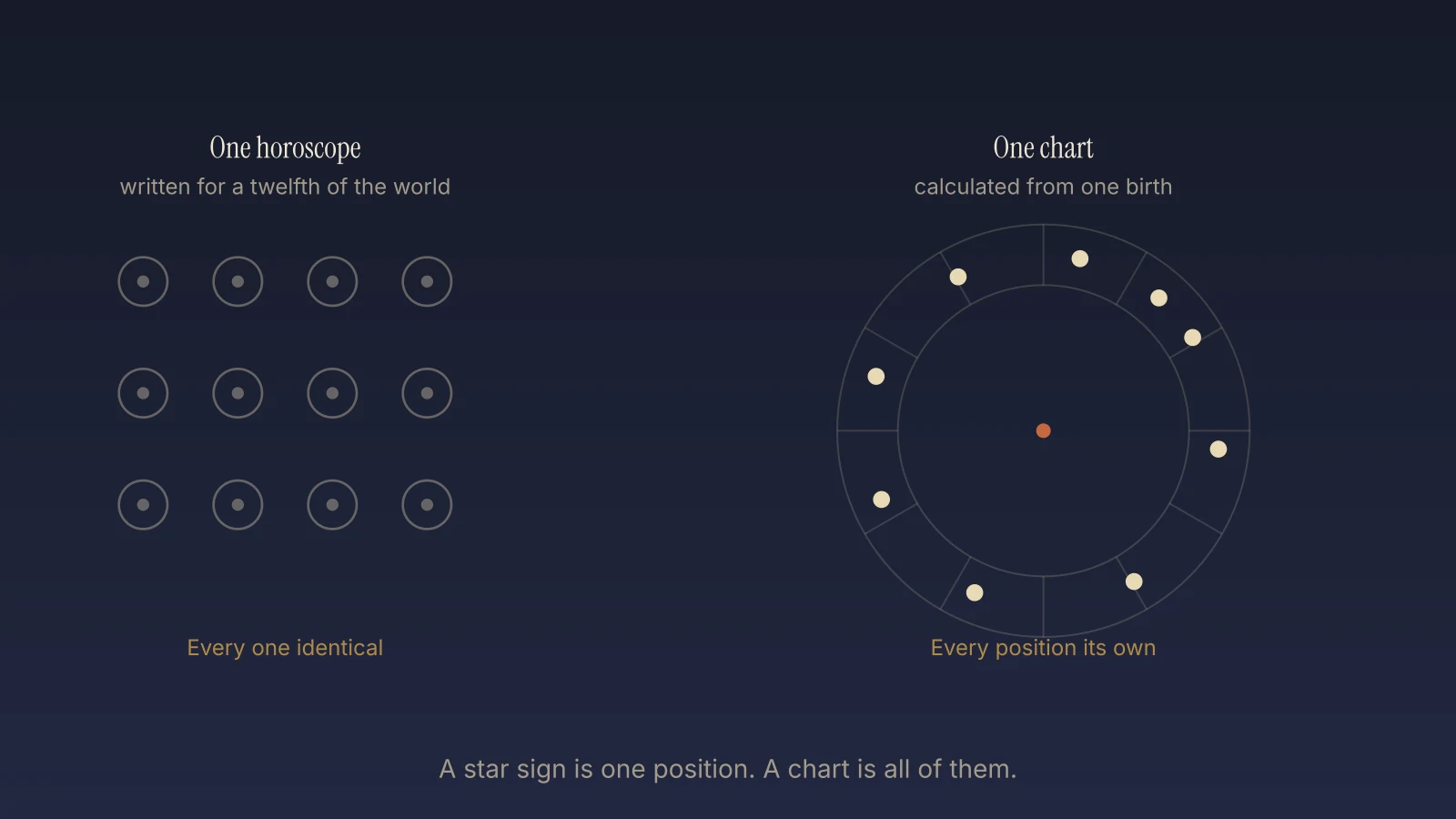
A daily horoscope is written once and read by everybody born in a four-week window — about 650 million people. It has to fit all of them, so it is written loosely enough to fit anyone, which is why it feels like it was meant for someone else and like it was meant for you at the same time. That is not a failure of the writer. It is arithmetic.
What is a star sign actually telling you?
Your star sign is where the Sun was on the day you were born, and nothing else. It is one position out of roughly a dozen that a birth chart records. Everything else — the Moon, the rising sign, where each planet sat and the angles between them — is thrown away when a reading is written from the Sun alone.
The Sun is a real and meaningful placement. The problem is proportion. Reducing a chart to its Sun is like describing a piece of music by naming its key: true, useful, and nowhere near enough to tell one piece from another.
Two people born on the same day an hour apart can have different rising signs, which moves every house boundary and relocates most of the chart. A horoscope written for their shared Sun sign cannot see any of that, because it was never given it.
Does a full birth chart fix it?
It fixes the arithmetic, which is the part that can be fixed. A chart calculated from your date, time and place puts every body where it actually was, to a fraction of a degree, and two astrologers working from the same details will produce the same chart. What that chart means is interpretation, and interpretation does not become a fact by being built on an accurate one.
This is the distinction worth carrying away from this whole article, because almost nothing in the category states it plainly: the calculation is checkable and the reading is not. Positions, aspects and the dates a transit is exact can all be verified against any published ephemeris. Whether Saturn crossing your Moon means what an astrologer says it means cannot be verified against anything.
An app that blurs the two is selling certainty it does not have. An app that keeps them apart can be genuinely useful without lying to you.
Where this is disputed
Astrologers disagree substantially about how to read a chart — which house system to use, how wide an orb counts, whether the outer planets matter in a natal reading. Anyone who tells you their method is the settled one is overstating a live argument.
What do you need a birth time for?
The rising sign and the houses, and a precise Moon. The rising sign changes about every two hours, so without a time it cannot be known at all, and the houses are built from it. The Moon moves roughly thirteen degrees a day, so a chart cast for noon can place it half a sign from where it was.
- Without a birth time
- Every planet from the Sun outwards is still right to a fraction of a degree, and the aspects between them hold. That is most of a chart.
- With a birth time
- The rising sign, all twelve house boundaries, and the Moon to the degree rather than to the sign.
Most people do not know their birth time, and a great many apps quietly invent a rising sign anyway rather than admit the gap. That is the moment an app stops being worth trusting, because it has just told you something it does not know.
OrbHeaven calculates your chart from whatever you have — date alone is enough to start — and says plainly which parts it cannot show rather than guessing at them. The chart, the glossary and thirty days of dated timeline are free.
About a minute. Birth time optional, and no account until after you have seen it.
Terms used here
Read next
Can an app tell you when something is going to happen?
It can tell you exactly when a planet reaches an angle to your chart, to the day, years ahead. It cannot tell you what will happen. The gap between those two sentences is the whole honest case for using one.
What changes if you write down what actually happened?
Almost every astrology app tells you something and never asks how it went. Keeping the answer turns a stream of readings into a record with outcomes attached — and a record is the only version of this that can tell you anything you did not already believe.
Does Mercury actually move backwards?
No. Nothing reverses. Mercury only appears to loop backwards against the stars because we are watching it from a planet that is itself moving — and knowing why makes the whole thing less mysterious and more interesting.
Written by Kevin Blaxton for OrbHeaven. About