What do tarot cards mean, and how does a tarot reading work?
Kevin Blaxton · 9 min read ·
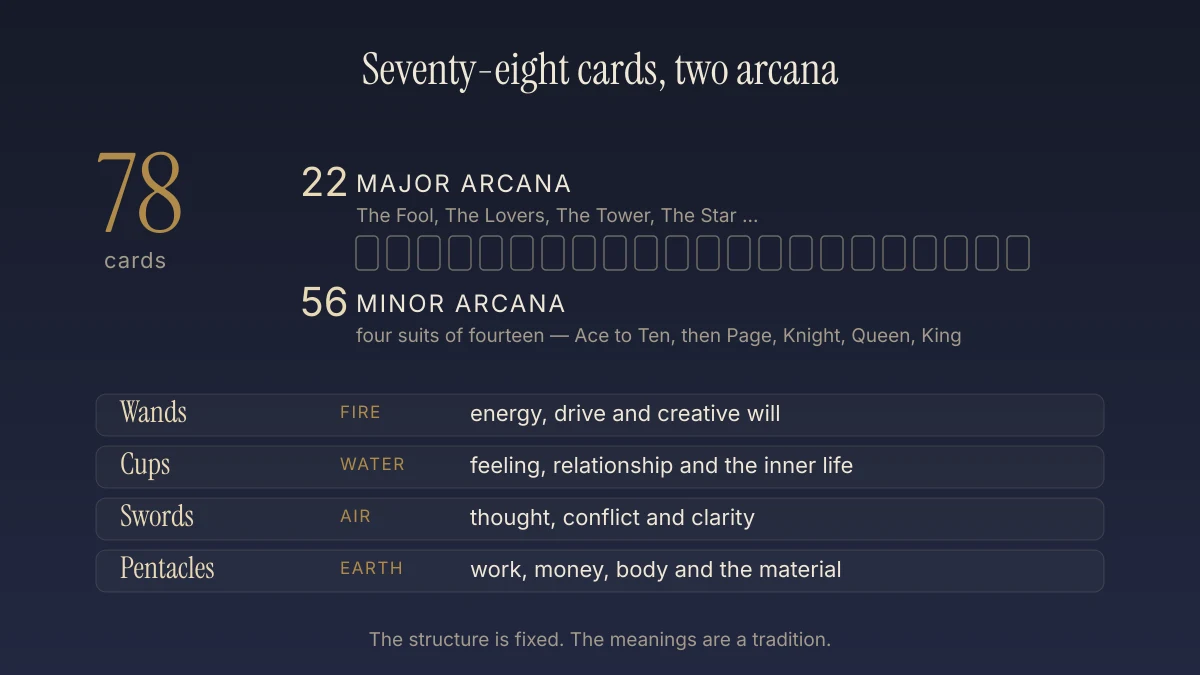
A tarot deck is a set of seventy-eight illustrated cards. Twenty-two of them, the Major Arcana, stand in tradition for the larger themes of a life; the other fifty-six, the Minor Arcana, come in four suits and cover its everyday texture. A reading lays some of them out in a pattern called a spread, and each position gives its card a role to play against the question you brought. The cards do not know what will happen. What they offer is a fixed set of images and traditional meanings to think your own situation against — a mirror, not a forecast.
Where do tarot cards come from?
Tarot began in fifteenth-century Europe as ordinary playing cards, made for trick-taking games that are still played in parts of Italy and France today. Reading the cards for insight is a later development, documented from the late eighteenth century onward. The deck most people picture — the Rider–Waite–Smith, drawn by Pamela Colman Smith and published in 1909 — is barely a century old.
The distinction is worth keeping. The cards are genuinely old, but the practice of divining with them, and most of the meanings now attached to them, grew over time rather than arriving intact from an ancient source. Treating the symbolism as a long interpretive tradition is accurate; treating it as a lost secret is not.
Two patterns dominate today. The Tarot de Marseille, a French woodcut standard with roots in the seventeenth and eighteenth centuries, keeps its numbered suits plain. The Rider–Waite–Smith gave every card a full illustrated scene, including the suits, which is why it became the common teaching deck and the basis for most modern variants.
What is inside a seventy-eight-card deck?
Two groups. The twenty-two Major Arcana are the named, numbered cards — The Fool, The Lovers, The Tower, The Star, and so on — and traditionally stand for the larger forces and turning points of a life. The fifty-six Minor Arcana are closer to a regular pack: four suits of fourteen cards, running Ace through Ten and then four court cards, the Page, Knight, Queen and King. The majors are read as the big themes, the minors as the daily texture.
A reading rarely uses the whole deck. The cards are shuffled, a few are drawn, and the rest stay in the pack. A Major Arcana card turning up is often read as the more significant of two — a theme that frames the smaller, situational detail the Minor Arcana describe.
What do the four suits mean?
Each suit carries a theme borrowed from one of the four classical elements. These associations are interpretive conventions rather than facts about the cards, but they are consistent enough across decks to be worth learning as a starting vocabulary. OrbHeaven uses the traditional readings below.
- Wands (fire)
- Energy, drive and creative will — ambition, action, and the spark that starts things.
- Cups (water)
- Feeling, relationship and the inner life — love, intuition, and emotional weather.
- Swords (air)
- Thought, conflict and clarity — decisions, truth, communication, and the mind cutting both ways.
- Pentacles (earth)
- Work, money, body and the material — the practical, tangible side of a situation.
How does a reading and a spread actually work?
You hold a question in mind, shuffle, and lay cards out in a fixed pattern called a spread. Each position in the spread has a meaning — the situation, an obstacle, the likely path — and the reader interprets each card through the lens of its position and the question. The same card means something different in the "obstacle" seat than in the "advice" seat, because the position supplies the frame.
A spread can be a single card for a daily focus, three cards for a short arc, or a larger layout for a fuller picture. The structure is what turns a random draw into something to reason with: it gives each image a specific job rather than leaving you to read tea leaves.
What is the difference between an upright and a reversed card?
A card drawn the right way up is read in its base sense; a card drawn upside down — reversed — is traditionally read as a shadow, blocked, or inward-turned version of the same meaning. The Star upright reads as renewal and hope with evidence; reversed, as discouragement or faith worn thin. Reversals are optional: many readers do not use them at all, and treat every card by its upright meaning.
Whether to read reversals is a style choice, not a rule, and it is one place readers openly differ. What matters is consistency within a reading: decide before you draw whether reversals are in play, so a card means the same thing whichever way it falls for you.
Can you walk through a three-card reading?
Take a simple three-card spread — situation, what helps, where it points — for a question like "I am unsettled at work; what should I pay attention to?" Suppose the draw is The Tower, then The Lovers, then The Star. None of these foretells an event. Each is a prompt: a traditional meaning, placed in a position, read against the question you asked.
The Tower in the first seat carries "sudden clarity, a structure that could not hold, disruption" — a reading that the unsettled feeling is a structure showing its cracks, not a random mood. The Lovers in the second, "a real choice, alignment, what you value made visible," points to a genuine decision about what you actually want, rather than a drift. The Star in the third, "renewal, hope with evidence, a quiet after difficulty," reads as a workable way through once the choice is faced.
Read together, the three make a sentence you could have reasoned your way to yourself: something is cracking, there is a real choice underneath it, and there is a way through. That is the honest value of a spread — not that the cards knew, but that laying them out gave the thought somewhere to stand.
Is tarot meant to predict the future?
No. Tarot is a reflective framework and not an established method of predicting events. The cards cannot tell you what will happen, and any reading that claims to is overstating what the practice can do. What a reading can do is give a question structure — a fixed set of images and meanings to turn your own situation over against, which is often enough to see it more clearly.
Used that way, tarot is a thinking tool rather than a fortune-telling device. The useful question after a reading is never "was it right?" but "did laying this out help me see my own situation more honestly?" That keeps the practice on the ground, where it belongs.
How do you choose a tarot deck?
For a beginner, the Rider–Waite–Smith is the usual recommendation, because every card carries a full illustrated scene that gives you something concrete to read, and most books and courses are written around it. The Tarot de Marseille is older and more austere, with plain numbered suits that lean on the reader to supply the meaning. Beyond those two, hundreds of modern decks reskin the same seventy-eight-card structure in different art.
The structure matters more than the pictures. Because almost every deck keeps the same seventy-eight cards, four suits and court ranks, a meaning you learn on one deck transfers to another; the art changes the mood, not the framework. A sensible first rule is to pick a deck whose images you genuinely want to look at, since you will be reading them closely, and to learn one deck well before collecting more.
How does OrbHeaven approach tarot?
OrbHeaven draws your cards by real chance, not from a fixed script, and labels every interpretation as interpretation rather than fact. A one-card reading, read against your own details, is free; fuller spreads and the full card record are part of Plus. The free Rider–Waite–Smith deck is included, with the Marseille and Night Orrery decks available on Plus.
Because the draw is random and the meanings are shown openly, you can see exactly what you were dealt and what the tradition reads into it — the same honesty OrbHeaven applies to a birth chart. You can try a sample reading on the public tarot page before signing in, and compare what a free tool and a paid plan each include on the pricing page.
What else do beginners ask about tarot?
A few questions come up again and again. None of them has a mystical answer, and the plain ones are more useful than the dramatic ones. Here are the common beginner questions, answered the way OrbHeaven would answer them anywhere else on the site.
- Do I need a special gift to read tarot?
- No. Reading tarot is learning a vocabulary of images and positions and applying it honestly. It is a skill, not a sense.
- Are "death" or "tower" cards bad omens?
- No. In tradition, Death reads as an ending and a change, and The Tower as sudden clarity — both are about transformation, not literal misfortune.
- Can a reading be wrong?
- A reading is not a prediction, so there is nothing to be right or wrong about. The only test is whether it helped you think more clearly.
- How is tarot different from astrology or numerology?
- All three are symbolic traditions. Tarot draws cards by chance; astrology and numerology are calculated from your birth details. OrbHeaven offers all three.
Tarot sits beside astrology and numerology inside OrbHeaven as one of three ways to explore the same questions — a symbolic tradition for reflection, shown with its workings open and its claims labelled. Draw a sample reading on the tarot page, see how the pieces fit together on the explore hub, or start with your free birth chart. Nothing here is sold as a forecast, because none of it is one.
About a minute. Birth time optional, and no account until after you have seen it.
Read next
How do you calculate your Life Path number in numerology?
Your Life Path number reduces your birth date to a single digit, or to a master number 11, 22 or 33. Here is the Pythagorean method worked step by step, what the numbers 1 to 9 and the master numbers traditionally mean, where conventions differ, and the mistakes that quietly change the answer.
What are the best free astrology birth chart calculators?
A free birth chart calculator places the Sun, Moon and planets in signs, degrees and aspects. Here is what five free ones verifiably show, and how to choose.
Why does every horoscope feel like it was written for someone else?
Because it was. A daily horoscope is written for a twelfth of the world at once. Here is what changes when a reading is calculated from your own birth details instead, and what honestly does not.
Written by Kevin Blaxton for OrbHeaven. About