Reference · Astrology
What is a conjunction?
Kevin Blaxton — software builder; astrology student for 40+ years · figures computed by the OrbHeaven engine
Published · Last revised
A conjunction is the aspect of 0°: two planets at the same degree of the zodiac, or close to it, seen in nearly the same direction along the ecliptic from the Earth. It is the tightest of the aspects, and the tradition reads the two planets as blended — acting as one.
What is a conjunction?
Geometrically it is an aspect of 0° — two planets at the same ecliptic longitude, so they lie in the same direction along the zodiac as seen from the Earth. They need not be close in space; they are close only in the one coordinate the chart measures, longitude along the ecliptic.
Because the two share a degree, they almost always share a sign, and the great conjunctions of the slow planets are visible in the real sky as two bright points nearly touching.
How it is counted: the orb
An exact conjunction is 0°, but the tradition allows an orb — a margin. OrbHeaven counts a conjunction when the two planets are within 8° of exact in a birth chart, widening to 9° when the Sun or Moon is one of the pair. The figure shows the geometry and that orb; the number comes straight from the engine’s orb table.
What it is read as
Interpretation, labelled as such: a conjunction is read as a fusion — the two planets combine their natures and act together, for better or worse. Whether the blend is easy or difficult is taken to depend on the planets involved, not on the angle itself, which is why the conjunction is not simply “good” or “bad”.
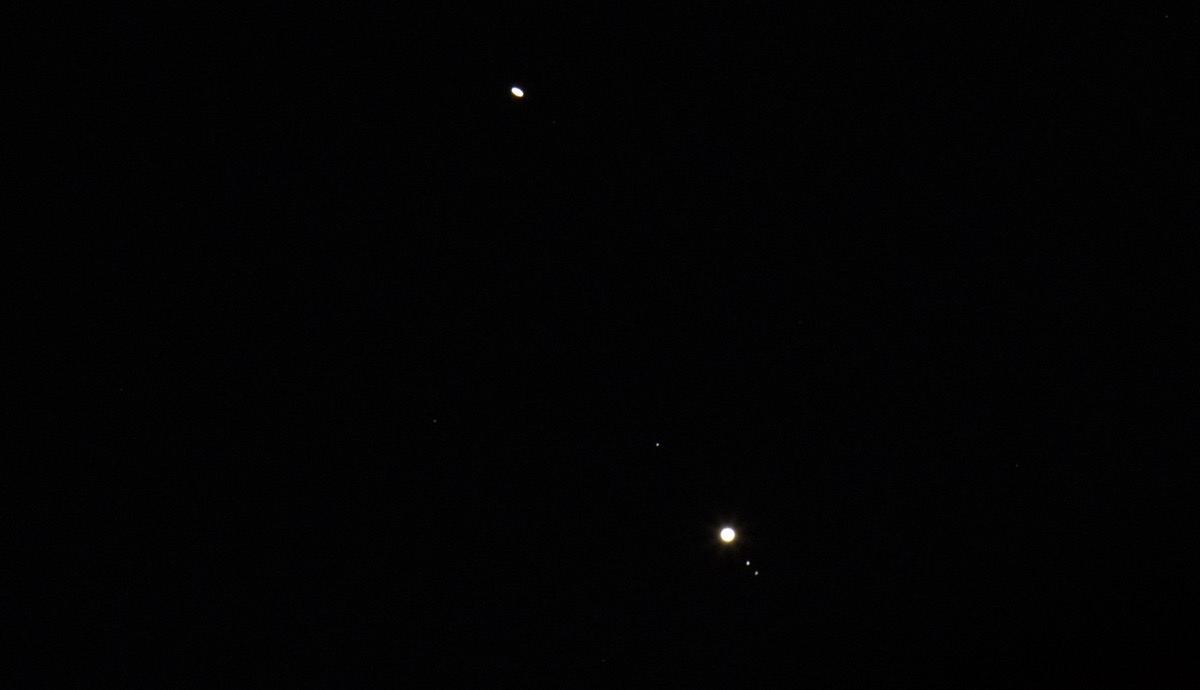
Source: NASA/Joel Kowsky · natural colour · U.S. public domain (courtesy NASA; no endorsement implied).
A short history
The conjunction is the oldest of the configurations: classical astrology spoke of planets “together” in one sign long before orbs were formalised. In Ptolemy’s scheme it is co-presence in a sign rather than one of the angular aspects; modern astrology treats it as the first of the five major aspects and counts it by orb.
Common misconceptions
- Are the two planets in a conjunction actually close together?
- Only in direction. They share almost the same ecliptic longitude as seen from Earth, but can be at very different distances in space. A conjunction is an alignment in the chart’s one coordinate, not a meeting.
- Is a conjunction a good aspect or a bad one?
- Neither by itself. It fuses the two planets’ natures; whether that reads as easy or difficult depends on which planets are involved.
References & further reading
- [1] Ptolemy, Tetrabiblos (2nd c. CE) — the classical doctrine of configuration and co-presence.
- [2] Tompkins, S., Aspects in Astrology — the modern interpretation of the conjunction.
- [3] OrbHeaven engine (astronomy-engine), aspects module — the 0° angle and the 8°/9° natal orb; re-derived in aspects-demo.test.ts.
Suggested citation
Blaxton, K. (2026). What is a conjunction. OrbHeaven Reference. https://orbheaven.com/reference/the-conjunctionRevision history
- First build (concise). Shared aspect-shape diagram (0°, engine orb) + reused NASA great-conjunction photo; links up to the Aspects hub and Orbs. Geometry, orb computation, tradition and history kept separate. No interactive.
Related glossary entries
About a minute. Birth time optional, and no account until after you have seen it.
More in the reference library
What is an aspect in astrology? The angles, the orbs, and the geometry
An aspect is the angle between two points in a chart. This is the geometry — the six angles astrologers use, what an orb is, and where the set comes from — with an interactive dial that classifies any separation using OrbHeaven’s engine.
What is an orb in astrology?
An orb is how far an aspect is from exact — and how far from exact still counts. This explains the arithmetic, OrbHeaven’s orb table and the luminary rule, with an interactive dial, and that orbs are a convention of practice, not a scientific threshold.
What is a new Moon?
A new Moon is the instant the Sun and Moon share the same ecliptic longitude — a conjunction, with the Moon between Earth and Sun and its lit side turned away. This explains the geometry, distinguishes the exact instant from the visible crescent, works a real example from the engine, and shows why most new Moons are not solar eclipses.