Reference · Astronomy
What is an aspect in astrology? The angles, the orbs, and the geometry
Kevin Blaxton — software builder; astrology student for 40+ years · figures computed by the OrbHeaven engine
Published · Last revised
An aspect is the angle between two points in a chart — usually two planets — measured the shorter way around the circle. Astrologers pay attention to a handful of specific angles; an aspect is said to count when the two points are within an allowed distance of one, called the orb. The angle is calculated; what it is taken to mean is interpretation.
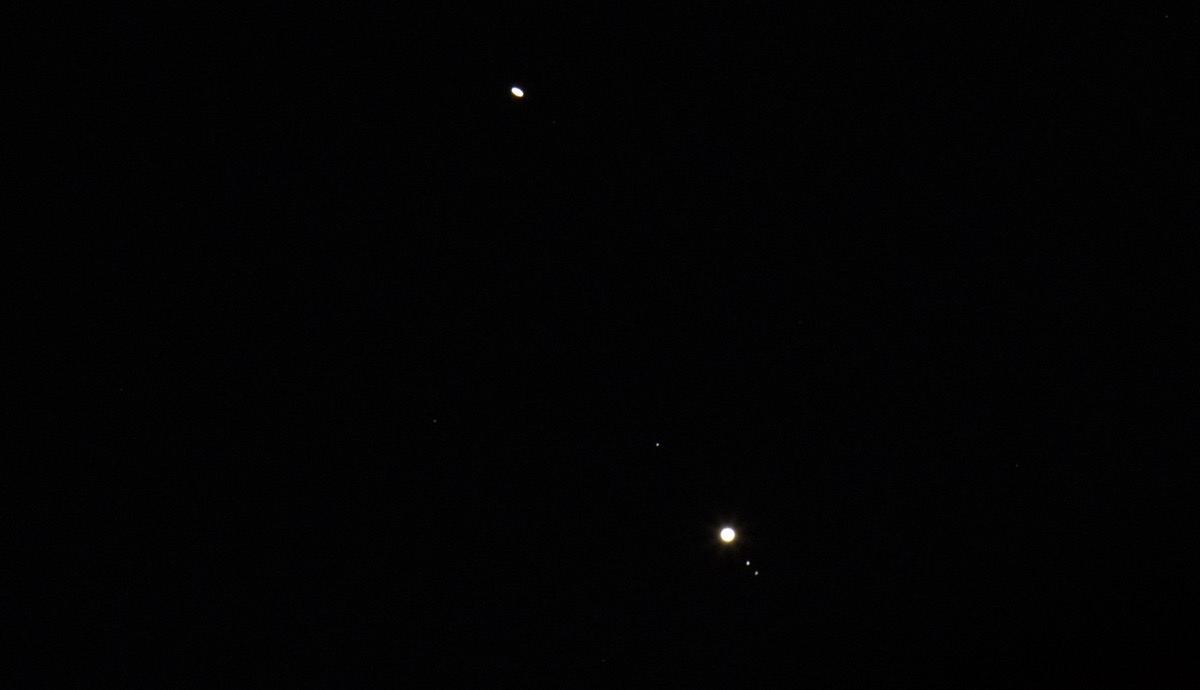
Source: NASA/Joel Kowsky · natural colour · U.S. public domain (courtesy NASA; no endorsement implied).
What is an aspect?
It is the angular separation between two points on the zodiac, measured along the circle the short way, so it runs from 0° to 180°. Two planets 90° apart are in a square; 120° apart, a trine. The separation is a plain geometric fact; whether a given angle “counts”, and what it signifies, are conventions laid on top of it.
Aspects are measured from the ecliptic degree of each point, not from their signs, so two planets at the same degree of different signs can form an exact aspect across a sign boundary. OrbHeaven’s birth charts also count aspects to the Ascendant and Midheaven.
Which angles count, and why these?
The core set comes from Ptolemy. In the 2nd century CE he set out the aspects as the configurations that divide the circle by simple ratios — sextile (60°), square (90°), trine (120°) and opposition (180°). A conjunction (0°) is strictly co-presence in a sign rather than an angle between separated bodies, though modern astrology counts it as the first of the five “major” aspects. The 150° quincunx was added later still and is disputed.
- Conjunction — 0°
- Two points together. Read as a blend; whether easy or difficult depends on the planets.
- Sextile — 60°
- A sixth of the circle. A soft aspect, read as opportunity.
- Square — 90°
- A quarter. A hard aspect, read as friction and drive.
- Trine — 120°
- A third. A soft aspect, read as ease.
- Quincunx — 150°
- Not one of Ptolemy’s configurations, and not everyone counts it; read as an awkward adjustment.
- Opposition — 180°
- A half. A hard aspect, read as tension across a polarity — the Full Moon is the Sun and Moon in opposition.
Kepler, in Harmonices Mundi (1619), later argued for the aspects on harmonic grounds — treating them as the musical ratios of the circle — which is one reason the set has endured.
What is an orb — when does an aspect count?
Two planets are almost never at a perfectly exact angle, so an aspect counts when the separation is within an allowed distance of exact, called the orb. The distance from exact is calculated; how wide an orb to allow is a convention. OrbHeaven’s birth charts allow 8° for a conjunction or opposition, 7° for a square or trine, 5° for a sextile and 2.5° for a quincunx, with 1° more when the Sun or Moon is involved.
Tighter aspects are generally given more weight. There is no universal orb table — different astrologers and software will count an aspect another leaves out. Move the dial below to see which aspect a given separation makes, and whether it is close enough to count, using OrbHeaven’s own orbs.
Aspect dial
Set the angle · see the aspect- Result
- square — within orb (7° allowed)
Try: set 92° — a square, within its 7° orb; nudge to 98° and it falls out. Tick the luminary box to widen every orb by 1°. Classified live by OrbHeaven’s engine (ASPECT_ANGLES + NATAL_ORBS).
Hard, soft, and what aspects are read as
Beyond the geometry, the tradition groups aspects by feel: the square and opposition (and often the conjunction) as “hard”, read as tension and drive; the trine and sextile as “soft”, read as ease and opportunity; the quincunx as a minor aspect of awkward adjustment.
Where this is disputed
Which aspects to count, how wide an orb to allow, and whether hard aspects are obstacles or engines of growth, all vary by school. The angles and orbs are calculated and stated; the meanings are a tradition, and we keep them apart.
Common misconceptions
- Are aspects about the signs?
- No. An aspect is the angle between two points in degrees. Two planets can be in an exact trine while sitting in signs that are not the “expected” pair, if they fall near a sign boundary.
- Does a wider orb mean a weaker aspect?
- In practice usually yes — the closer to exact, the more weight the tradition gives it — but how much is a convention, not a measurement.
- Is the quincunx a real aspect?
- Many astrologers count it and others leave it out. OrbHeaven counts it with a tight orb and flags that it is disputed.
References & further reading
- [1] Ptolemy, Tetrabiblos I.13–14 (c. 150 CE) — the classical doctrine of the aspects (the four configurations); conjunction is treated as co-presence, not an aspect.
- [2] Kepler, J., Harmonices Mundi (1619) — the harmonic account of the aspects.
- [3] Meeus, J., Astronomical Algorithms, 2nd ed. (Willmann-Bell, 1998) — angular separation on the sphere.
Suggested citation
Blaxton, K. (2026). What is an aspect in astrology? The angles, the orbs, and the geometry. OrbHeaven Reference. https://orbheaven.com/reference/aspectsRevision history
- First build. The aspect wheel and the interactive dial are driven by OrbHeaven’s engine (ASPECT_ANGLES + NATAL_ORBS + the luminary-orb rule) and re-derived by aspects-demo.test.ts. Imagery: NASA/Joel Kowsky photograph of the December 2020 Jupiter–Saturn great conjunction (U.S. public domain).
Related glossary entries
About a minute. Birth time optional, and no account until after you have seen it.
More in the reference library
What is the Ascendant, and why does your birth time decide it?
The rising sign is the degree of the zodiac climbing over the eastern horizon at your exact birth moment and place — explained with the celestial-sphere geometry, an engine-computed interactive, and why signs rise unevenly.
Why do planets seem to move backwards? Apparent retrograde motion
Planets never reverse. Retrograde motion is an illusion of perspective as Earth overtakes them — explained with orbital geometry, a worked example from our engine, and the history from Ptolemy to Kepler.