What is the difference between an applying and a separating aspect?
Kevin Blaxton · 6 min read ·
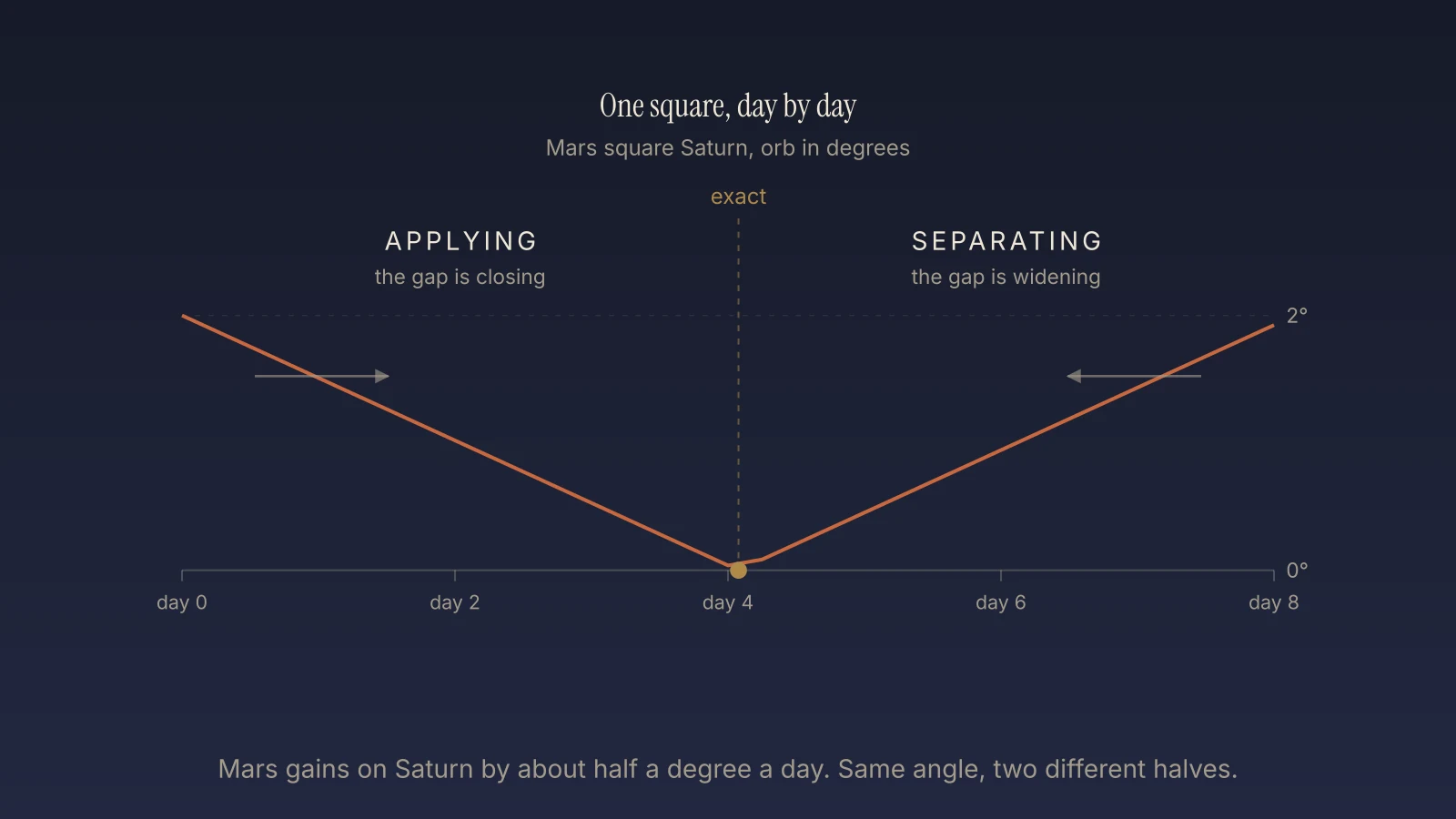
An applying aspect is still tightening: the faster planet is moving toward the exact angle and has not reached it yet. A separating aspect has already been exact and is widening again. That is the whole distinction, and it is arithmetic rather than interpretation — you can work out which one you are looking at from two numbers, the gap between the planets and the direction that gap is moving. The tradition reads an applying aspect as a theme still building and a separating one as a theme already largely worked through, and most astrologers give the applying side more weight.
What does it mean for an aspect to be applying?
It means the two planets have not finished making the angle yet. An aspect is measured as the gap between two positions, and planets move at different speeds, so that gap is always changing. While the faster planet is still closing on the exact angle — 90° for a square, 120° for a trine — the aspect is applying. The moment it passes exactness the same pair begins separating, and the gap widens from then on.
Nothing switches on or off at the boundary. An aspect two degrees from exact and closing, and the same aspect two degrees from exact and widening, are the same angle measured at two different moments in one continuous movement. The two words name which half of that movement you are standing in.
This is also why the orb matters. An aspect is only counted at all if it falls within a few degrees of exact, so applying and separating describe the approach to and retreat from the middle of that window, not the whole of a planet’s journey round the chart.
How can you tell which one you are looking at?
Compare speed and direction. Work out the gap between the two planets now, then ask whether the faster of them is moving toward the exact angle or away from it. If the gap is closing, the aspect is applying; if it is widening, it is separating. Speed decides it, not which planet sits earlier in the zodiac — and a planet in retrograde motion can reverse the answer entirely.
The speeds are very unequal, which makes this easier than it sounds. The Moon covers about thirteen degrees a day, the Sun about one, Mars about half, and Saturn about three hundredths. In almost every pair one planet is doing nearly all the moving, so the question is really just which way that one is headed.
What does this look like with real numbers?
Take Mars at 17° Aries and Saturn at 19° Cancer. Measured round the circle from the start of Aries, Mars sits at 17° and Saturn at 109°, so the gap between them is 92°. A square is 90°, which puts the pair 2° from exact — an orb of two degrees. Mars covers roughly half a degree a day and Saturn about three hundredths, so the gap is closing at about half a degree a day. The aspect is applying, and it perfects in roughly four days.
Reverse one number and the reading reverses with it. Put Saturn at 19° Gemini instead and the gap becomes 62°, which is nowhere near a square; put Mars at 21° Aries with Saturn still at 19° Cancer and the gap is 88°, two degrees past exact and widening, so the same pair at the same orb is now separating.
The daily motions used here are averages. Real ones vary through a planet’s orbit, and either body can be retrograde, which is why a chart calculates the instant rather than estimating from a rule of thumb.
Are applying aspects stronger than separating ones?
Most astrologers say so, and read an applying aspect as the live one — the thing still building — while a separating aspect describes something already largely worked through. It is a convention with a long history rather than a measurement. Nothing in the arithmetic makes one stronger than the other: the calculation says which is which, and the weighting on top of it is interpretation.
Where this is disputed
Some astrologers weight separating aspects just as heavily in a birth chart, on the grounds that a completed aspect is a finished piece of character rather than an unfinished one. And a planet that turns retrograde before reaching exactness never completes the aspect at all — read by some as a theme that never quite lands, and by others as no different from any other applying aspect.
Every aspect in an OrbHeaven chart is labelled applying or separating with its orb in degrees beside it, because the calculation produces both and there is no reason to show only half of it. The chart is free and needs no account, so the quickest way to stop this being abstract is to draw your own and look at what is still closing.
About a minute. Birth time optional, and no account until after you have seen it.
Terms used here
Read next
Does Mercury actually move backwards?
No. Nothing reverses. Mercury only appears to loop backwards against the stars because we are watching it from a planet that is itself moving — and knowing why makes the whole thing less mysterious and more interesting.
Why is your star sign not where the stars actually are?
If you are a Leo, the Sun was probably in front of Cancer when you were born. The zodiac has drifted about a sign away from the constellations it was named after, and most astrology uses the drifted version on purpose.
What is a solar return, and why is it not always your birthday?
It is the moment each year when the Sun comes back to the exact degree it held when you were born. That moment lands about six hours later each year, which is why it can fall a day either side of the date on your certificate.
Written by Kevin Blaxton for OrbHeaven. About