What changes if you write down what actually happened?
Kevin Blaxton · 4 min read ·
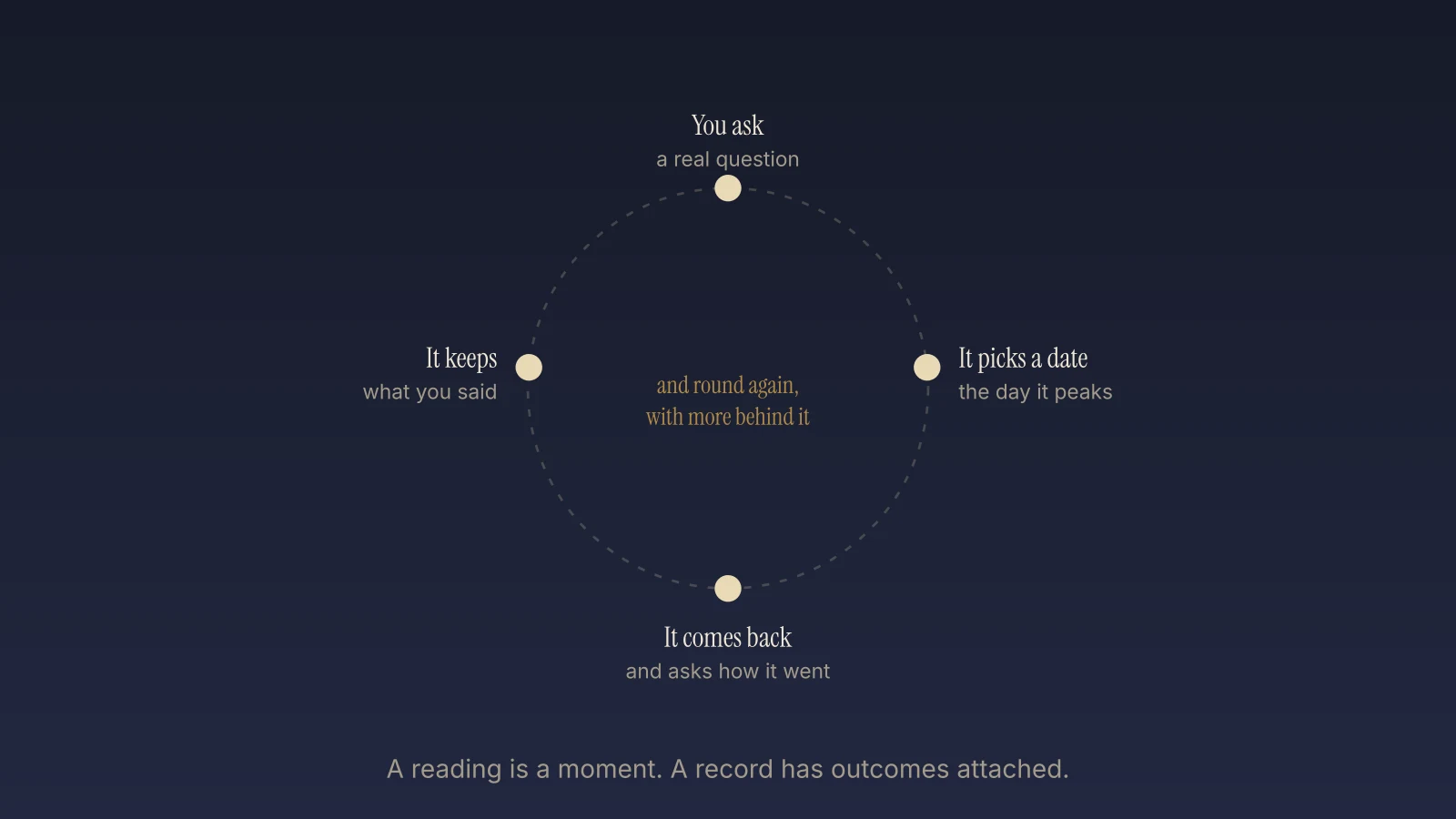
A reading is a moment. You read it, it either lands or it does not, and by Thursday it is gone. Nothing accumulates, nothing is ever checked, and a year later you have had three hundred readings and know nothing you did not know at the start. Writing down what actually happened is the cheap, unglamorous step that changes what the whole practice is worth.
Why does nothing ever come back and ask?
Because asking is a risk. A product that tells you something and moves on can never be wrong in a way you notice. A product that comes back on the date and asks what happened is handing you the evidence to judge it by, and most of the category would rather not.
There is a commercial reason too. Readings are cheap to produce and easy to consume, so an app that produces more of them looks busier and feels more generous. A check-in produces nothing to read. It just asks a question and stores one sentence.
But the check-in is the only part that compounds. The three hundredth reading is worth exactly what the first was. The three hundredth answer sits on top of two hundred and ninety-nine others.
What can a record tell you that a reading cannot?
Which kinds of stretch you actually find hard, as opposed to which ones you expect to. After a few months of recorded outcomes, the pattern that emerges is about you rather than about the tradition, and it is frequently not the pattern the tradition would predict.
- What you keep asking about
- The subject you return to under pressure, which is rarely the one you would have named.
- Which transits you handle well
- Some of the ones with fearsome reputations turn out to be unremarkable for you, and some mild ones do not.
- Whether any of it holds up
- The uncomfortable one, and the reason a record is worth keeping even if you are sceptical.
None of that can be written in advance, by anyone, because it is made of your own answers. It is the one thing in this category that cannot be generated, which is also why almost nothing offers it.
Does this work if you are not sure you believe any of it?
Better, arguably. A record of questions asked at decision points, with what happened attached, is a useful document whatever you think the planets have to do with it. You end up with a dated log of what you were weighing and how it turned out, which is more than most people keep about their own lives.
The astrology decides when to come back and ask. That is a legitimate job for it even on the most sceptical reading: it is a scheduling mechanism that picks a date you did not pick, which is precisely what makes it a fair test rather than a self-selected one.
If after six months the pattern says nothing, you have lost nothing and learned something real. That is the offer.
OrbHeaven plans the date when you ask the question, comes back on it, and keeps your answer. Over months it reads that record back to you, from your own words rather than from your birthday. It is free to build the record; reading it back is what Plus is for.
About a minute. Birth time optional, and no account until after you have seen it.
Terms used here
Read next
Why does every horoscope feel like it was written for someone else?
Because it was. A daily horoscope is written for a twelfth of the world at once. Here is what changes when a reading is calculated from your own birth details instead, and what honestly does not.
Can an app tell you when something is going to happen?
It can tell you exactly when a planet reaches an angle to your chart, to the day, years ahead. It cannot tell you what will happen. The gap between those two sentences is the whole honest case for using one.
Does Mercury actually move backwards?
No. Nothing reverses. Mercury only appears to loop backwards against the stars because we are watching it from a planet that is itself moving — and knowing why makes the whole thing less mysterious and more interesting.
Written by Kevin Blaxton for OrbHeaven. About