Reference · Astronomy
What is the Ascendant, and why does your birth time decide it?
Kevin Blaxton — software builder; astrology student for 40+ years · figures computed by the OrbHeaven engine
Published · Last revised
The Ascendant, or rising sign, is the degree of the zodiac rising over the eastern horizon at the exact moment and place you were born. Because the Earth turns once a day, that point sweeps through the whole zodiac every twenty-four hours — about one new sign every two hours — so it depends on the time and the location, not just the date.

Source: NASA (STS-43) · natural colour · U.S. public domain (courtesy NASA; no endorsement implied).
What is the Ascendant?
It is the point where the ecliptic — the Sun’s yearly path, along which the Moon and planets also travel — crosses your eastern horizon at a given instant. Astrologers call the sign containing that point the rising sign, and it marks the start of the first house.
The word “rising” is literal: as the Earth rotates, the whole sky appears to turn, and new degrees of the zodiac climb over the eastern horizon while others set in the west. The Ascendant is simply whichever degree is on the eastern horizon at the moment in question. It is a point, not a planet — there is nothing there to see.
Why does it need an exact time and place?
Because the rising point moves fast. The sky turns a full circle in about a day, so the Ascendant travels through all twelve signs in twenty-four hours — roughly a new sign every two hours. Two people born the same day a few hours apart, or the same minute a thousand miles apart, can have different rising signs.
That is why the Ascendant, the Midheaven and the whole system of houses need a birth time and place, while the Sun’s sign needs only the date. Move the time and the location below and watch the rising sign change.
Rising-sign explorer
Move birth time & locationYour eastern horizon — the clay mark is what is rising.
How long each sign takes to rise, at this latitude.
- Rising sign
- ♓ Pisces
- Degree
- 24.8°
- Sidereal time
- 06:00
- Latitude
- 51°N
- This sign is
- rising fast (short ascension)
Try: hold the time and drag the latitude from the equator to Reykjavík — the rising-rate bars stretch dramatically, and a few minutes of birth time can swap the rising sign. Computed live by the OrbHeaven engine (computeHouses).
The geometry: where the ecliptic meets the eastern horizon
Picture the sky as a sphere around you. Your horizon cuts it in half; the celestial equator and the ecliptic are two great circles tilted across it. The Ascendant is where the ecliptic crosses the horizon in the east. Its position is fixed by two things: your local sidereal time — how far the sky has turned — and your latitude, which tilts the circles.
In OrbHeaven’s engine this is computed from the right ascension of the midheaven (the local sidereal time), the true obliquity of the ecliptic for the date, and the observer’s latitude. Positions are tropical and times are UTC; the rising degree agrees with modern ephemerides to well within the minute shown.
Why do some signs rise faster than others?
A new sign rises roughly every two hours — but not evenly. Because the ecliptic is tilted to the horizon, some signs climb steeply and quickly while others lie almost flat and take far longer, and the effect grows with latitude. These are the signs of “short” and “long” ascension.
The figure below is computed by the engine: at London’s latitude the slowest-rising sign takes roughly three times as long as the fastest. Drag the latitude in the explorer above from the equator toward the far north and the bars stretch dramatically — one reason birth-time accuracy matters most at high latitudes.
Where the rising sign comes from
The rising point has been central to astrology since antiquity. Hellenistic astrologers called it the horoskopos — literally “hour-marker” — and the cast chart took its name, the horoscope, from it. Computing it by hand drove centuries of work on tables of ascensions and instruments such as the astrolabe and the armillary sphere.
Finding where the ecliptic met the horizon for a given hour and place is one of the oldest applied problems in spherical astronomy — the same geometry an armillary sphere models in brass, and the same calculation the engine now does in a fraction of a second.
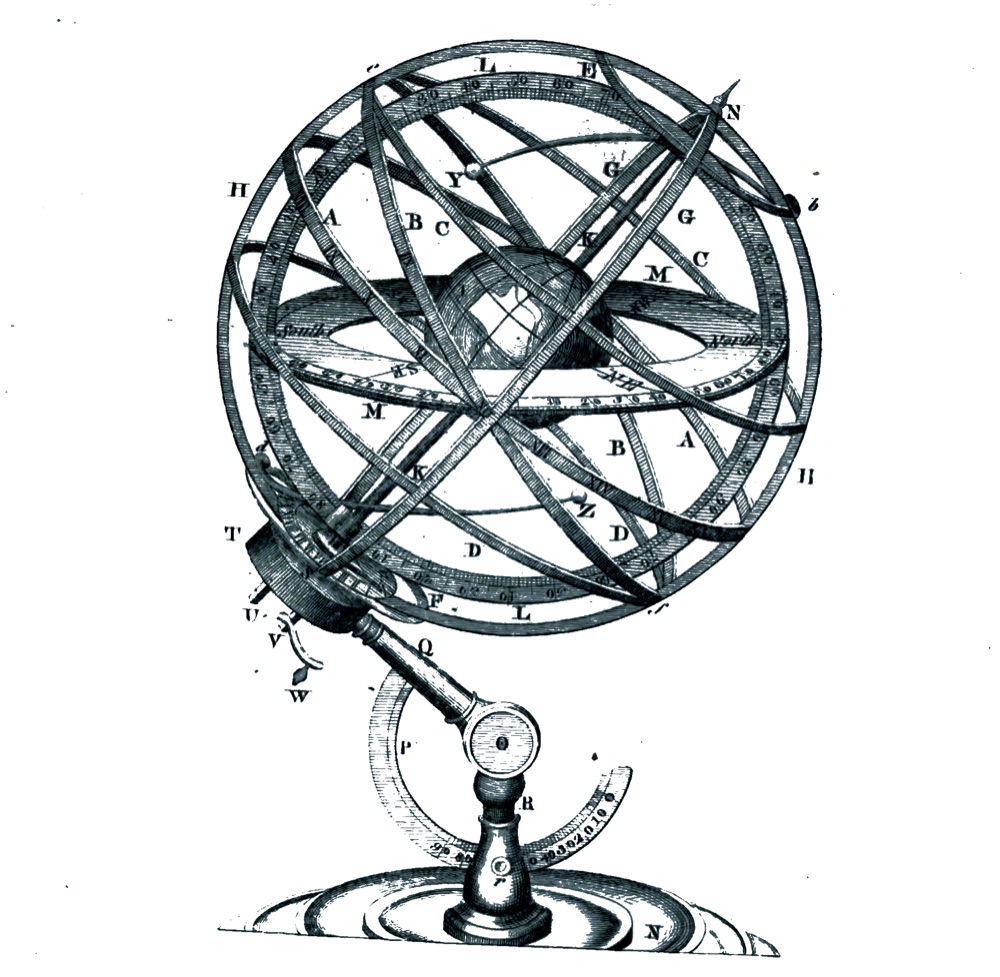
Source: Andrew Bell, Encyclopaedia Britannica (1st ed., 1768–71) · historical diagram · public domain.
What is the rising sign read as?
Here the register changes from fact to interpretation. The tradition reads the Ascendant as the face you present and the way you meet the world — the lens the rest of the chart is seen through — and it sets where all twelve houses begin.
Where this is disputed
How much the rising sign shapes character versus mere first impression, and which house system best divides the space it opens, are long-running debates. The horizon geometry is exact and the same for everyone; the meaning is a tradition, and we keep the two apart.
Common misconceptions
- Is the rising sign the same as my Sun sign?
- No. The Sun sign is where the Sun sat on your birth date; the rising sign is the degree of the zodiac climbing the eastern horizon at your birth time, which changes every couple of hours.
- Do I really need my exact birth time?
- For the Ascendant, yes. An hour’s error can shift it into the next sign — and the effect is strongest at high latitudes, where some signs rise very quickly.
- Is the Ascendant a planet?
- No. It is a point — the place the ecliptic meets the eastern horizon — not a body. Nothing is physically there.
References & further reading
- [1] Meeus, J., Astronomical Algorithms, 2nd ed. (Willmann-Bell, 1998) — sidereal time and the ascendant.
- [2] NASA / JPL — Solar System Dynamics, HORIZONS (celestial coordinates and sidereal time).
- [3] Smart, W. M., Textbook on Spherical Astronomy — oblique ascension and ascensional difference.
- [4] Ptolemy, Tetrabiblos, and Hellenistic sources — the horoskopos (historical).
Suggested citation
Blaxton, K. (2026). What is the Ascendant, and why does your birth time decide it. OrbHeaven Reference. https://orbheaven.com/reference/the-ascendantRevision history
- First build. The rising-sign explorer and the rising-rate figure are computed by the OrbHeaven engine (computeHouses) and re-derived by ascendant-demo.test.ts. Imagery: NASA STS-43 Earth-limb sunrise (U.S. public domain) and a public-domain 1768–71 Encyclopaedia Britannica armillary-sphere engraving.
Related glossary entries
About a minute. Birth time optional, and no account until after you have seen it.