Reference · Astronomy
What is a full Moon?
Kevin Blaxton — software builder; astrology student for 40+ years · figures computed by the OrbHeaven engine
Published · Last revised
A full Moon is the moment the Sun and Moon reach opposite points of the zodiac — about 180° apart in geocentric ecliptic longitude. The Earth then lies roughly between them, so the whole sunlit face of the Moon is turned toward us and we see a full disc. It is a precise instant, the midpoint of the roughly 29.5-day cycle that began at the new Moon, and in most months it passes without a lunar eclipse.
What is a full Moon, astronomically?
It is the instant when the Moon and the Sun are about 180° apart in ecliptic longitude — an opposition, an elongation of 180°. The Earth lies roughly between the two, so sunlight reaches the hemisphere of the Moon that faces us, and the Moon appears as a full, round disc. It is the exact counterpart of the new Moon, half a cycle on.
Because the Moon is opposite the Sun, a full Moon always falls in the sign opposite the Sun’s: a full Moon in Cancer happens while the Sun is in Capricorn. It rises around sunset, is highest near midnight, and sets around sunrise — opposite the Sun all night.
The diagram shows the arrangement from above: sunlight from the left, the Earth in the middle, and the Moon beyond it with its near side fully lit.
The exact instant versus the nights around it
The full Moon is a single calculated instant — the moment of exact opposition — but the Moon looks “full” to the eye for about a night either side of it. Near opposition the illuminated fraction changes very slowly, so the disc is more than 99% lit for roughly a day before and after, and the difference is hard to see without measurement.
This is why a calendar may show the full Moon on a date when, for your time zone, the exact instant fell the previous evening or the following morning. The instant is precise; the look of fullness is not. The Lunar Reconnaissance Orbiter image shows the fully lit disc at opposition.
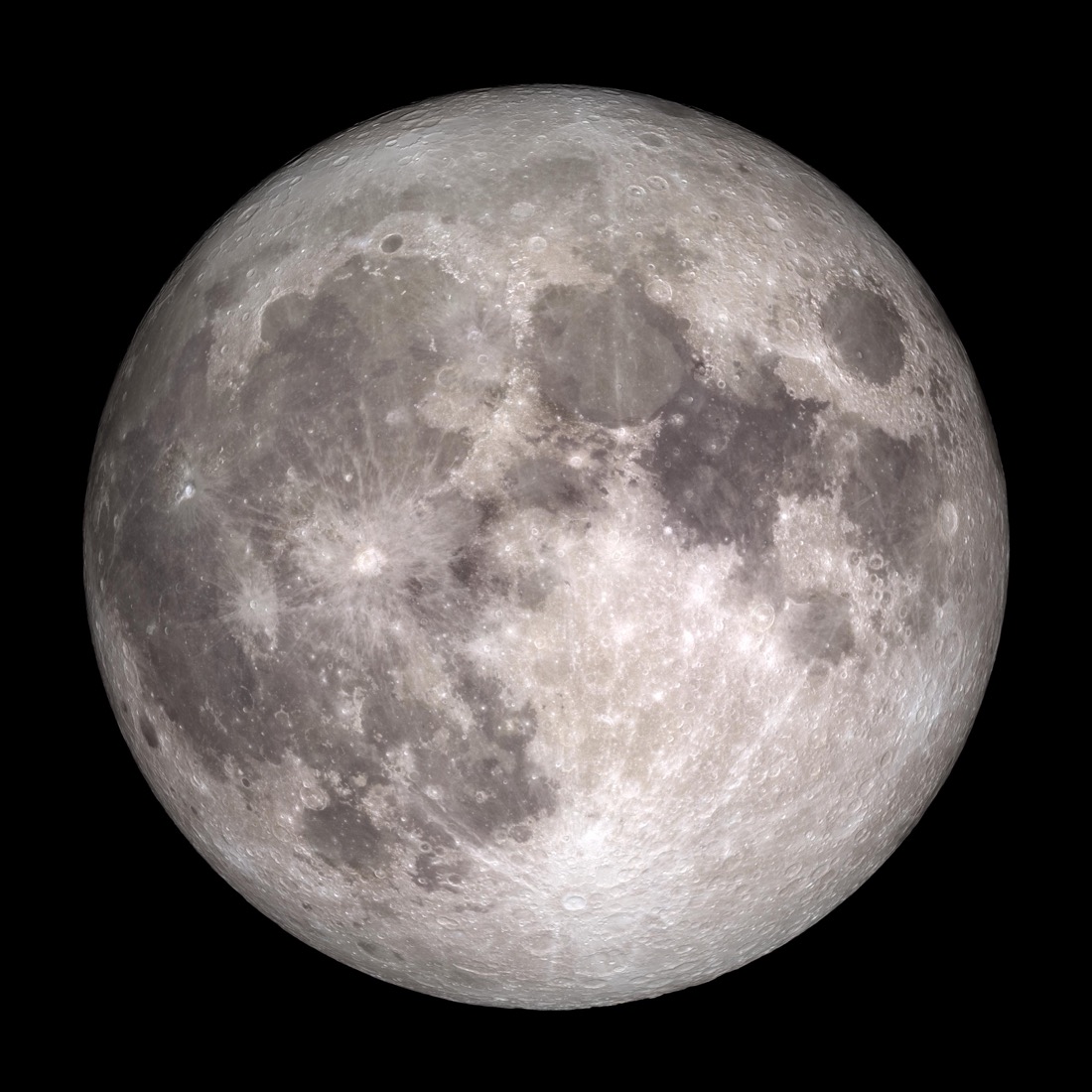
Source: NASA/GSFC (Lunar Reconnaissance Orbiter) · natural colour · U.S. public domain (courtesy NASA; no endorsement implied).
A worked example, from the engine
Take the full Moon after 1 January 2025 — January’s “Wolf Moon”. OrbHeaven’s engine finds the opposition at 13 January 2025, 22:27 UTC, with the Sun at 23°59′ Capricorn and the Moon directly opposite at 24°00′ Cancer: a separation of 179.99°. The Moon was about 4.6° north of the ecliptic at that instant, and the nearest point where its orbit crosses the ecliptic was over five days away.
The assumptions are the engine’s defaults: geocentric apparent ecliptic longitude, true equinox of date; the full-Moon instant is found by searching for the moment the Sun–Moon elongation is 180°. The date and positions match published almanacs for the January 2025 full Moon. No value here is typed in — every number is read from the same ephemeris the charts use, and the test suite re-derives them.
That 4.6° of latitude is the reason this full Moon was an ordinary one and not an eclipse, as the next section explains.
Why isn’t every full Moon a lunar eclipse?
Because the Moon’s orbit is tilted about 5.1° to the ecliptic, so at most full Moons the Moon passes a little above or below the long cone of the Earth’s shadow rather than through it. A lunar eclipse needs the full Moon to fall close to a node — the points where the tilted orbit crosses the ecliptic — so that the Sun, Earth and Moon line up closely enough in latitude for the shadow to fall on the Moon.
In the worked example the Moon was about 4.6° north of the ecliptic at the opposition, with the nearest node more than five days away — far outside the roughly one-degree latitude window in which the Earth’s shadow can reach it. So the Moon passed north of the shadow, and the full Moon was ordinary.
It is the same node geometry that governs solar eclipses at the new Moon, read half a cycle on: eclipses come in seasons, when the nodes line up with the Sun. The full treatment is in The Lunar Nodes; the figure below is the same tilted-orbit picture.
A short history
The full Moon has been a timekeeper and a marker of the month’s midpoint for as long as people have watched the sky. Lunisolar calendars set festivals by it, and many cultures gave the year’s full Moons names tied to the season — the Harvest Moon nearest the autumn equinox, and the folk names (Wolf, Snow, Harvest) now printed in almanacs. Its brightness, rising as the Sun sets, made it the natural light for travel and work after dark.
Because a lunar month is about 29.5 days and a calendar month a little longer, two full Moons occasionally fall in one calendar month; the second has come to be called a “blue Moon”, a matter of the calendar rather than the sky.
What a full Moon means in the tradition
Interpretation, labelled as such: astrology reads the full Moon as a culmination — the Sun and Moon in opposition, a matter coming to light or to a head — the fruition of what the new Moon began two weeks earlier. It is read in the polarity of the two signs it falls across, and in the house it occupies in a chart.
Where this is disputed
How much a full Moon “means”, and the popular belief that it stirs behaviour or sleep, are interpretation; controlled studies have not found a reliable lunar effect on human behaviour. The instant and the degrees are computed exactly; the meanings read into them are tradition, and we keep the two apart.
Common misconceptions
- Is the full Moon full for a whole night, or an instant?
- The exact full Moon is a single instant of opposition, but the disc looks full to the eye for about a night either side, because the lit fraction changes very slowly near opposition (over 99% lit for roughly a day before and after).
- Why isn’t there a lunar eclipse every full Moon?
- Because the Moon’s orbit is tilted about 5° to the ecliptic, so most full Moons the Moon passes above or below the Earth’s shadow. An eclipse needs the full Moon near a node, where the orbit crosses the ecliptic and the three bodies line up in latitude.
- Does the full Moon affect behaviour or sleep?
- It is a long-standing belief, but controlled studies have not found a reliable effect of the full Moon on human behaviour. The astronomy is exact; the behavioural claim is not supported.
References & further reading
- [1] Meeus, J., Astronomical Algorithms, 2nd ed. (Willmann-Bell, 1998) — lunar phases, opposition, and the ecliptic limits for eclipses.
- [2] Espenak, F. (NASA GSFC), Five Millennium Canon of Lunar Eclipses — the node geometry and ecliptic limits that make a lunar eclipse.
- [3] OrbHeaven engine (astronomy-engine), lunation module — the full-Moon instant, the Moon’s ecliptic latitude and the node gap; re-derived in the test suite.
Suggested citation
Blaxton, K. (2026). What is a full Moon. OrbHeaven Reference. https://orbheaven.com/reference/the-full-moonRevision history
- First build. Original Sun–Earth–Moon opposition geometry diagram + reused NASA LRO full-Moon image (U.S. public domain, natural colour) and reused node-geometry figure; worked example (full Moon 13 Jan 2025, Sun 23°59′ Capricorn opposite Moon 24°00′ Cancer, Moon 4.6° north, node 5+ days away) re-derived in lunation-demo.test.ts and matching published almanacs. Distinguishes the instant from the nights of apparent fullness; separates calendar/folk history and tradition (incl. the unsupported behavioural claim) from astronomy; cross-links The New Moon and The Lunar Nodes. No interactive.
Related glossary entries
About a minute. Birth time optional, and no account until after you have seen it.
More in the reference library
What is a new Moon?
A new Moon is the instant the Sun and Moon share the same ecliptic longitude — a conjunction, with the Moon between Earth and Sun and its lit side turned away. This explains the geometry, distinguishes the exact instant from the visible crescent, works a real example from the engine, and shows why most new Moons are not solar eclipses.
What are the lunar nodes, and why do eclipses happen there?
The lunar nodes are the two points where the Moon’s tilted orbit crosses the Sun’s path. Eclipses can only happen near them. This covers the geometry, mean versus true node, the history (Rahu and Ketu), and what the tradition reads into them.
What are your Sun, Moon and rising signs — the “big three”?
The Sun, Moon and rising sign are the three placements most astrologers start with. This explains what each one is astronomically — the Sun’s apparent position, the Moon’s actual position, the geometric Ascendant — how much birth information each needs, and what the tradition reads into them.