Reference · Astronomy
What are the lunar nodes, and why do eclipses happen there?
Kevin Blaxton — software builder; astrology student for 40+ years · figures computed by the OrbHeaven engine
Published · Last revised
The lunar nodes are the two points where the Moon’s orbit crosses the ecliptic — the Sun’s apparent path. They are not bodies; nothing is there. They matter in astronomy because eclipses can only happen when a New or Full Moon falls near a node, and in astrology because the tradition reads them as an axis of growth and release.
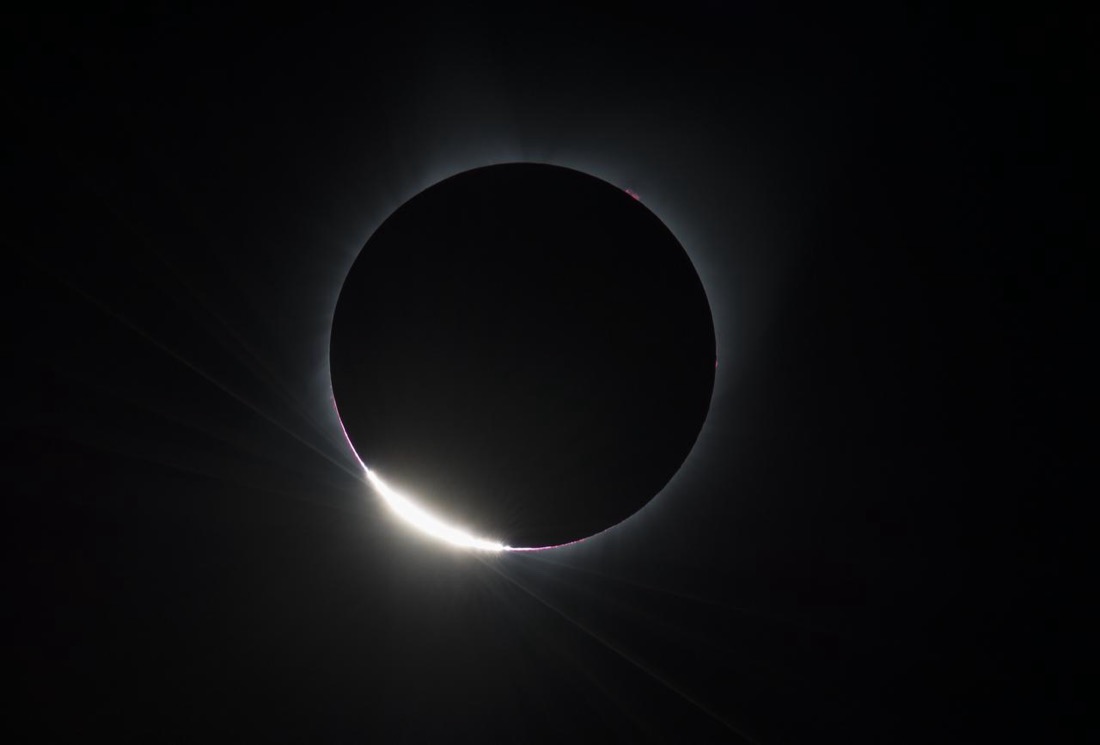
Source: NASA/Aubrey Gemignani · natural colour · U.S. public domain (courtesy NASA; no endorsement implied).
What are the lunar nodes?
The Moon’s orbit is tilted about 5° to the ecliptic, so for half of each month the Moon is above the Sun’s path and for half below. The two points where it crosses are the nodes: the ascending (North) node, where it crosses going north, and the descending (South) node, directly opposite. They are always exactly 180° apart.
They are points, not objects — there is nothing physically at a node. Because the Moon’s orbit itself slowly rotates, the nodes drift steadily backwards around the zodiac, completing a circuit in about 18.6 years.
Mean node and true node
The Moon’s orbit wobbles, so the nodes can be given two ways. The true node is the exact, instantaneous crossing point, which drifts backwards but briefly jitters forwards; the mean node is that motion averaged into a smooth, always-backward drift. They differ by up to about 1.5°.
OrbHeaven uses the mean node — the older convention — and says so. Neither is more “correct”; they answer slightly different questions, and the difference is small enough that it rarely changes a sign.
The nodes and eclipses
Most New Moons pass above or below the Sun, and most Full Moons above or below the Earth’s shadow, because of that 5° tilt. Only when a New Moon or Full Moon happens near a node do the three bodies line up closely enough for an eclipse — a solar eclipse at the New Moon, a lunar eclipse at the Full.
This is why eclipses come in seasons about six months apart, when the Sun is near the node axis. OrbHeaven does not compute or predict eclipses; it locates the nodes and the lunations, and this page explains the geometry rather than forecasting any particular eclipse.
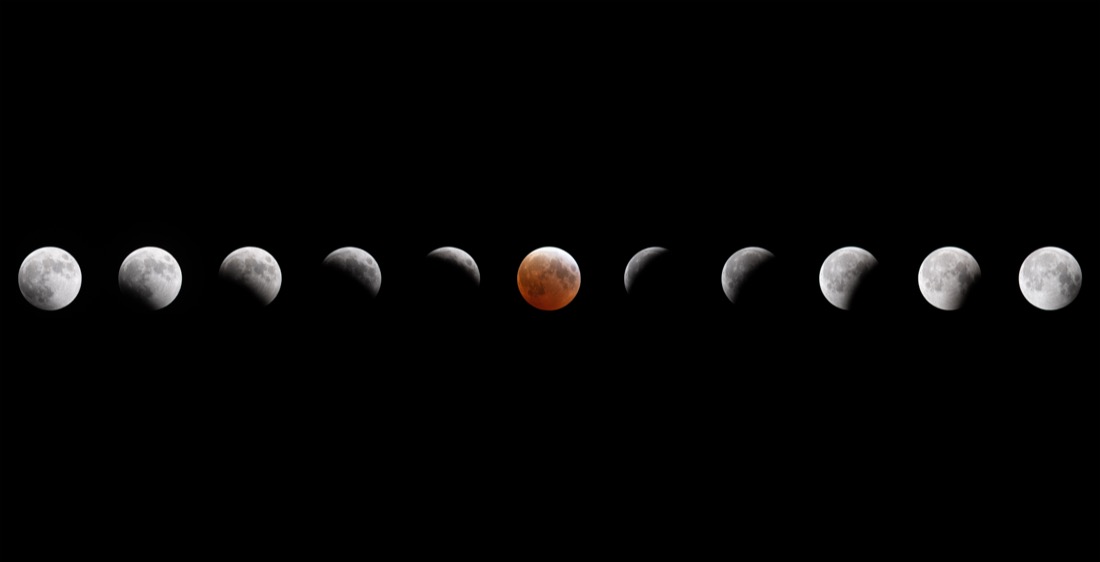
Source: NASA/GRC/Jordan Cochran · composite · U.S. public domain (courtesy NASA; no endorsement implied).
Rahu, Ketu, and the dragon
The nodes are old and were vivid long before their geometry was understood. In Indian astrology they are Rahu (north) and Ketu (south), treated almost as shadow-planets; in the medieval West they were the dragon’s head and tail — caput and cauda draconis — the creature imagined to swallow the Sun at an eclipse.
Predicting where the nodes would be, and so when eclipses could occur, drove some of the oldest exact astronomy: the Babylonian Saros cycle of about 18 years already let eclipses be anticipated thousands of years ago.
What the nodes are read as
Interpretation, labelled as such: the tradition reads the North Node as a direction of growth — the unfamiliar thing worth reaching for — and the South Node as what already comes easily and can be leaned on less. They are an axis, always read as a pair.
Where this is disputed
Whether the nodes are a karmic axis, how much weight they carry, and whether to use the mean or true node, all vary by astrologer. The geometry and the eclipse conditions are exact and the same for everyone; the meaning is a tradition, and we keep the two apart.
Common misconceptions
- Are the lunar nodes planets or stars?
- Neither. They are the two points where the Moon’s orbit crosses the ecliptic — geometry, not objects. Nothing is physically there.
- Why isn’t there an eclipse at every New and Full Moon?
- Because the Moon’s orbit is tilted ~5°, so most New and Full Moons pass above or below the alignment. An eclipse needs a lunation near a node.
- Does OrbHeaven predict eclipses?
- No. It locates the nodes and the lunations and explains the geometry; it does not compute or forecast specific eclipses.
References & further reading
- [1] NASA — solar and lunar eclipses: geometry, types, and why they occur in seasons.
- [2] Meeus, J., Astronomical Algorithms, 2nd ed. (Willmann-Bell, 1998) — the lunar nodes, mean vs true, and eclipse conditions.
- [3] Neugebauer, O., A History of Ancient Mathematical Astronomy — the Saros and ancient eclipse prediction.
Suggested citation
Blaxton, K. (2026). What are the lunar nodes, and why do eclipses happen there. OrbHeaven Reference. https://orbheaven.com/reference/the-lunar-nodesRevision history
- First build. Original node-geometry diagram (Moon’s orbit crossing the ecliptic); NASA imagery — the 2017 total solar eclipse (NASA/Aubrey Gemignani) and a 2025 total lunar eclipse composite (NASA/GRC/Jordan Cochran), both U.S. public domain. OrbHeaven uses the mean node. No eclipse computation or prediction (decision G6); no interactive.
Related glossary entries
About a minute. Birth time optional, and no account until after you have seen it.
More in the reference library
What is the tropical zodiac, and why are the signs not the constellations?
The tropical zodiac measures the signs from the March equinox, not from the stars — which is why, after millennia of precession, the signs no longer line up with their constellations. With engine-computed tropical/sidereal/constellation comparisons.
What is an aspect in astrology? The angles, the orbs, and the geometry
An aspect is the angle between two points in a chart. This is the geometry — the six angles astrologers use, what an orb is, and where the set comes from — with an interactive dial that classifies any separation using OrbHeaven’s engine.
Why do planets seem to move backwards? Apparent retrograde motion
Planets never reverse. Retrograde motion is an illusion of perspective as Earth overtakes them — explained with orbital geometry, a worked example from our engine, and the history from Ptolemy to Kepler.