Reference · Astronomy
What are your Sun, Moon and rising signs — the “big three”?
Kevin Blaxton — software builder; astrology student for 40+ years · figures computed by the OrbHeaven engine
Published · Last revised
Your Sun, Moon and rising signs are the three placements most astrologers start with. The Sun is what you are building toward, the Moon is what you need to feel at home, and the rising sign is how you come across — the lens the rest of the chart is seen through. Astronomically they are three different kinds of thing, and they need different amounts of birth information to pin down.
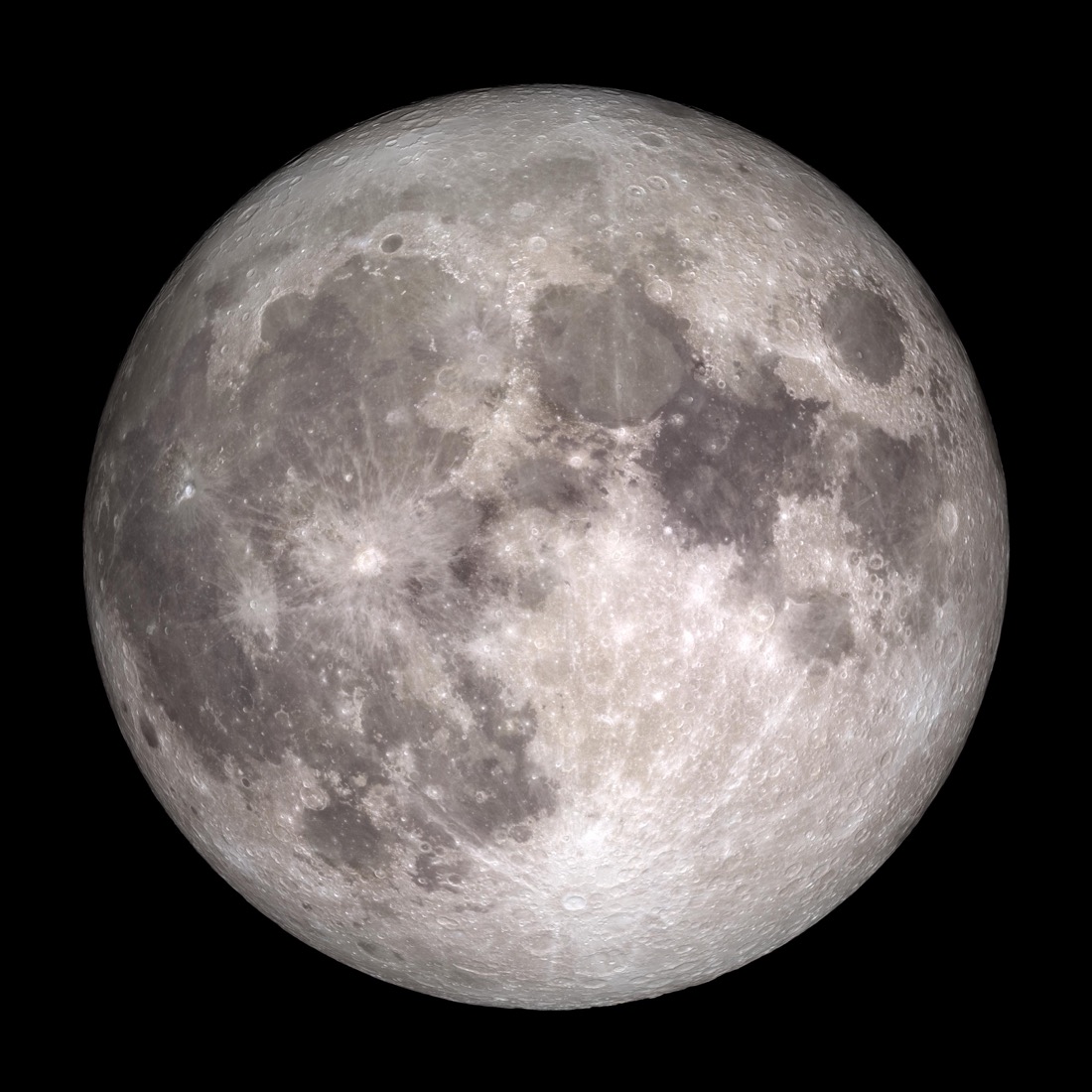
Source: NASA/GSFC (Lunar Reconnaissance Orbiter) · natural colour · U.S. public domain (courtesy NASA; no endorsement implied).
What are the big three?
Three different kinds of position. The Sun sign is the Sun’s apparent place on the ecliptic as seen from Earth. The Moon sign is the Moon’s actual position in its orbit around us. The rising sign, or Ascendant, is not a body at all — it is the point of the ecliptic climbing over the eastern horizon at your birth (see the Ascendant).
Because they are different sorts of thing, they behave differently: the Sun drifts slowly, the Moon races, and the rising point whips around once a day.
How much birth information each needs
It follows directly from how fast each moves. The Sun covers about 1° a day, so the date almost always fixes its sign. The Moon covers about 13° a day and changes sign every two and a bit days, so the time often matters. The Ascendant sweeps the whole zodiac in a day — on average about 1° every four minutes, though its rate varies with latitude and the rising sign — so it needs the exact time and place.
The comparison below puts the three side by side. The gulf between them is the reason “what time were you born?” matters so much more for the rising sign than for the Sun.
Why accurate birth time matters — most of all for the rising
A birth time wrong by an hour rarely moves the Sun and only sometimes moves the Moon — but it can easily move the Ascendant into the next sign, and with it the whole house framework. A wrong place does the same. This is why a rounded or guessed birth time is most visible in the rising sign.
If the time is unknown, the Sun’s sign usually still holds and the Moon’s often does, but the rising sign and the houses cannot be found at all.
The three in a real chart
Here is the engine’s example chart, where the Sun, Moon and Ascendant each sit at their calculated places. The wheel is deterministic — the same birth details always give the same three — and this is the same calculation behind the free birth chart.
Build your own from your birth details at the free birth chart.
The example chart, calculated
Calculated with astronomy-engine 2.1.19 · tropical zodiac · mean lunar node · placidus houses
Why “the big three”? A modern shorthand
The phrase is recent. Sun-sign astrology — “what’s your sign?” — is largely a 20th-century popular development, born with newspaper and magazine columns that needed something everyone could look up from a birthday alone. Traditional astrology leaned on the whole chart, and especially the rising sign.
The “big three” framing — Sun, Moon and rising together — is a modern compromise: richer than a Sun sign alone, quick enough to share, and a natural doorway into the full chart.
What the tradition reads into them
Interpretation, labelled as such: the Sun is read as core identity and what you are growing toward, the Moon as your inner, emotional needs, and the rising as your outward manner and the lens the chart is seen through. Together they sketch a person more fully than any one sign.
Where this is disputed
Which of the three matters most is itself a tradition-dependent disagreement: Western astrology usually leads with the Sun, while Indian (sidereal) astrology leads with the Moon. The positions are exact and the same for everyone; the emphasis and the meanings are a tradition, and we keep them apart.
Common misconceptions
- Is my Sun sign my “real” sign?
- It is one of three starting placements, not the whole story. The Moon and the rising sign often describe someone as much as the Sun, and the rising needs your exact birth time.
- Why do I need a birth time if I already know my Sun sign?
- The Sun sign usually comes from the date alone, but the rising sign and the houses depend on the exact time and place, and the Moon’s sign sometimes does too.
- Is the rising sign a planet?
- No. It is a point — where the ecliptic meets the eastern horizon — not a body. It is calculated from your time and place.
References & further reading
- [1] Meeus, J., Astronomical Algorithms, 2nd ed. (Willmann-Bell, 1998) — positions of the Sun, Moon and the ascendant.
- [2] Campion, N., Astrology and Popular Religion in the Modern West — the rise of 20th-century sun-sign astrology.
- [3] NASA — the Moon (Lunar Reconnaissance Orbiter).
Suggested citation
Blaxton, K. (2026). What are your Sun, Moon and rising signs — the “big three”. OrbHeaven Reference. https://orbheaven.com/reference/sun-moon-and-risingRevision history
- First build. Original three-components comparison (real daily motions; √-scaled bars) plus the reused engine example chart (ChartWheel, snapshot-tested). Imagery: NASA/GSFC Lunar Reconnaissance Orbiter full Moon (U.S. public domain). Distinguishes the Sun’s apparent position, the Moon’s actual position and the geometric Ascendant; links the live /birth-chart tool. No interactive (reuses engine figures).
Related glossary entries
About a minute. Birth time optional, and no account until after you have seen it.
More in the reference library
What is the Ascendant, and why does your birth time decide it?
The rising sign is the degree of the zodiac climbing over the eastern horizon at your exact birth moment and place — explained with the celestial-sphere geometry, an engine-computed interactive, and why signs rise unevenly.
What is a birth chart, and how is one built?
A birth chart is a map of the sky at the moment and place you were born. This explains how one is assembled — the frame, the signs, the planets, the houses and aspects — reusing OrbHeaven’s engine, and where calculation ends and interpretation begins.
What is the tropical zodiac, and why are the signs not the constellations?
The tropical zodiac measures the signs from the March equinox, not from the stars — which is why, after millennia of precession, the signs no longer line up with their constellations. With engine-computed tropical/sidereal/constellation comparisons.