What is a solar return, and why is it not always your birthday?
Kevin Blaxton · 4 min read ·
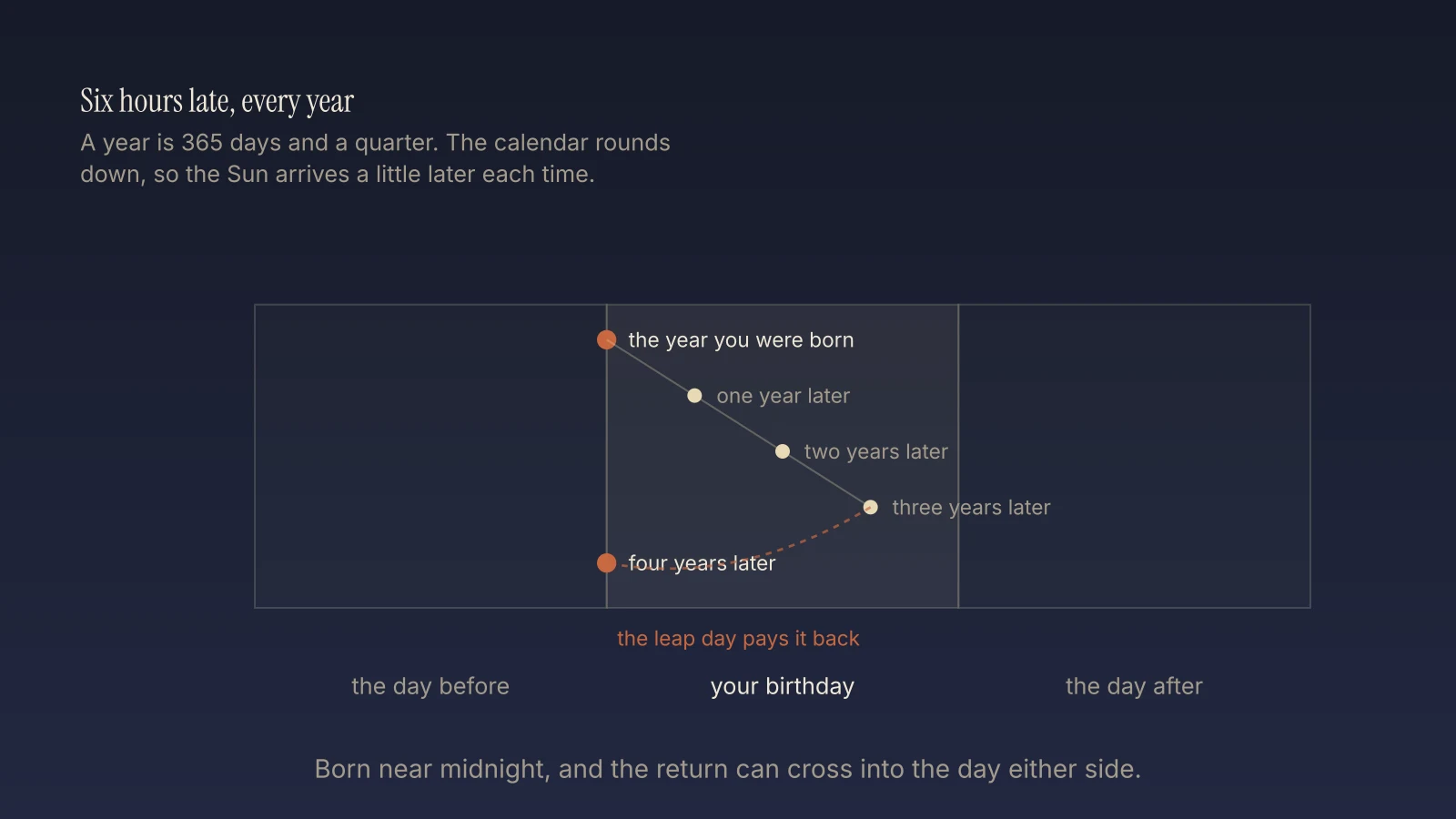
A solar return is the instant the Sun returns to the exact longitude it occupied at your birth — not the date, the instant, to the minute. A year is not a whole number of days: it is about 365 days and six hours, which is why we add a day every four years. So your solar return drifts about six hours later each year until a leap day pulls it back, and in some years it falls on the day before or after the date you celebrate.
Why does it move around?
Because the calendar and the orbit do not agree. The Earth takes about 365.2422 days to return to the same point relative to the equinox, and the calendar uses 365. That leftover quarter-day accumulates: roughly six hours a year, a whole day every four, which the leap day removes. Your solar return follows the orbit, so it slides against the calendar by about six hours annually and jumps back after each 29 February.
This is the same arithmetic that makes the equinox itself land on the 19th, 20th or 21st of March in different years. Nothing unusual is happening to you; the calendar is a rounding of the orbit and the rounding has to be paid back.
If you were born close to midnight, that drift is enough to move the return across the date line into the previous or following day fairly often.
What do astrologers do with it?
They cast a chart for that exact instant, usually at wherever you are living now rather than where you were born, and read it as a portrait of the year that the birthday opens. It is a well-established technique with a long history, and like every interpretive technique it is a reading rather than a measurement.
The calculated part is exact and uncontroversial: the instant can be found to the second, and any two people computing it properly will agree. Finding it means solving for when the Sun’s longitude equals its natal value, which is a numerical search rather than a lookup, and it is why a solar return is one of the few astrological moments that genuinely cannot be estimated by eye.
The interpretive part is where the usual caution applies. A solar return chart describes conditions the tradition associates with the year ahead. It does not know what will happen in your year, and a good reading of one will not pretend to.
Where this is disputed
Astrologers disagree about where to cast it: at your birthplace, at your current home, or at a place you deliberately travel to in order to shape the year. The last practice, "relocating" for a solar return, is popular in some circles and dismissed in others.
Is there a simpler version of the same idea?
Every planet has a return, and the ones that matter most are simply the slowest. Your Saturn return is the roughly twenty-nine-and-a-half years Saturn takes to come back to its birth position, which is why it lands around ages 29 and 58. The Moon returns every month. The Sun, once a year, is the one that happens to line up with a birthday.
Seen that way, a solar return is not a mystical event but a unit of measurement: it is what one lap actually is, measured against the sky rather than against a printed calendar. The tradition’s interest in it follows from that, rather than the other way round.
OrbHeaven finds the solar-return instant by numerical search rather than approximation, casts it where you are now, and says on the page that it can differ by a day from the date on your certificate — because the first time that happens, it looks like a bug, and it is not.
About a minute. Birth time optional, and no account until after you have seen it.
Terms used here
Read next
Does Mercury actually move backwards?
No. Nothing reverses. Mercury only appears to loop backwards against the stars because we are watching it from a planet that is itself moving — and knowing why makes the whole thing less mysterious and more interesting.
Why is your star sign not where the stars actually are?
If you are a Leo, the Sun was probably in front of Cancer when you were born. The zodiac has drifted about a sign away from the constellations it was named after, and most astrology uses the drifted version on purpose.
Why does every horoscope feel like it was written for someone else?
Because it was. A daily horoscope is written for a twelfth of the world at once. Here is what changes when a reading is calculated from your own birth details instead, and what honestly does not.
Written by Kevin Blaxton for OrbHeaven. About