Does Mercury actually move backwards?
Kevin Blaxton · 5 min read ·
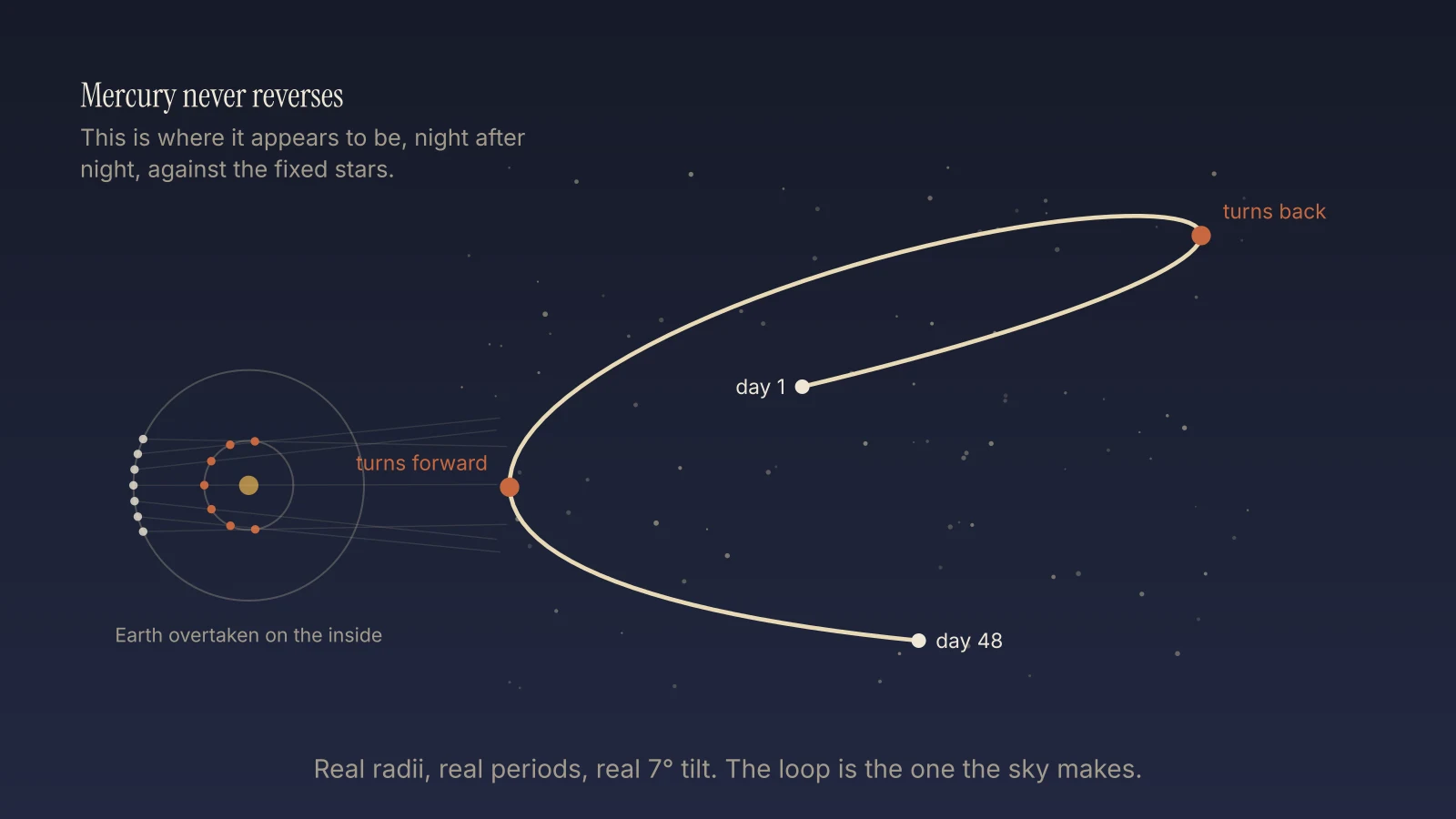
No. Mercury never slows, stops or reverses. It goes round the Sun in the same direction at roughly 47 kilometres a second, without interruption, forever. What changes is where we are standing. Three or four times a year, Earth and Mercury line up such that Mercury appears to trace a backwards loop against the background stars, and that apparent loop is what "retrograde" names. The motion is real; the backwardness is a trick of perspective.
Why does it look like it is going the wrong way?
Because you are overtaking it, or being overtaken. Think of passing a slower car on a motorway: as you draw level and pass, the other car appears to slide backwards against the hills behind it, even though it is still going forwards. Mercury orbits faster than Earth, so it laps us — and as it sweeps past on the inside, it appears against the stars to slide the other way.
The word for what you are seeing is parallax. The planet has not changed direction. Your viewing angle has swung through enough of an arc, fast enough, to outrun the planet’s own motion across the sky.
The same thing happens with every planet, not just Mercury. Mars appears to loop backwards roughly every two years, Jupiter every thirteen months, and the outer planets spend something like forty per cent of the year apparently retrograde. Mercury is simply the one people have heard of, because it happens often enough to notice and has acquired a reputation.
How often does it happen, and for how long?
Mercury appears retrograde three, occasionally four, times a year, for about three weeks each time — roughly a fifth of every year. The Sun and the Moon never do it at all, because the Sun is what we are orbiting and the Moon is orbiting us, so neither can be overtaken in the way that produces the effect.
- Station retrograde
- The day the apparent backwards motion begins, when the planet seems to pause against the stars before reversing.
- Station direct
- The day it appears to resume forwards. The astrological tradition reads both stations as more significant than the weeks between them.
- The shadow period
- The stretch either side, when the planet is crossing degrees it will cross again. Some astrologers count it and some do not.
Does any of it affect anything?
Not physically, and the numbers are not close. Mercury is between about 77 and 222 million kilometres away and exerts a gravitational pull on you that is smaller than the pull of the building you are sitting in. Nothing about its apparent direction changes anything measurable on Earth, including electronics, travel or anyone’s ability to send an email.
What the astrological tradition does with retrograde motion is separate, and worth understanding on its own terms rather than being confused with physics. It reads an apparent turning-inward as a period for reviewing, revising and returning to things rather than starting them — a metaphor drawn from the appearance, not a claim about the mechanism.
That is a reasonable thing to find useful and an unreasonable thing to be frightened of. Treated as a prompt to check your work before you send it, it costs nothing. Treated as a reason to cancel a contract, it is making a decision for you that it has no standing to make.
Where this is disputed
Controlled studies have not found effects on the outcomes commonly attributed to Mercury retrograde. Astrologers vary widely in how much weight they give it, and a good number consider the popular version overstated.
OrbHeaven calculates every station to the day from a modern ephemeris, shows you which of your own chart's degrees the planet will cross twice, and labels the calculated part and the interpreted part separately, so you can always see which is which.
About a minute. Birth time optional, and no account until after you have seen it.
Terms used here
Read next
Why is your star sign not where the stars actually are?
If you are a Leo, the Sun was probably in front of Cancer when you were born. The zodiac has drifted about a sign away from the constellations it was named after, and most astrology uses the drifted version on purpose.
What is a solar return, and why is it not always your birthday?
It is the moment each year when the Sun comes back to the exact degree it held when you were born. That moment lands about six hours later each year, which is why it can fall a day either side of the date on your certificate.
Why does every horoscope feel like it was written for someone else?
Because it was. A daily horoscope is written for a twelfth of the world at once. Here is what changes when a reading is calculated from your own birth details instead, and what honestly does not.
Written by Kevin Blaxton for OrbHeaven. About