Why is your star sign not where the stars actually are?
Kevin Blaxton · 6 min read ·
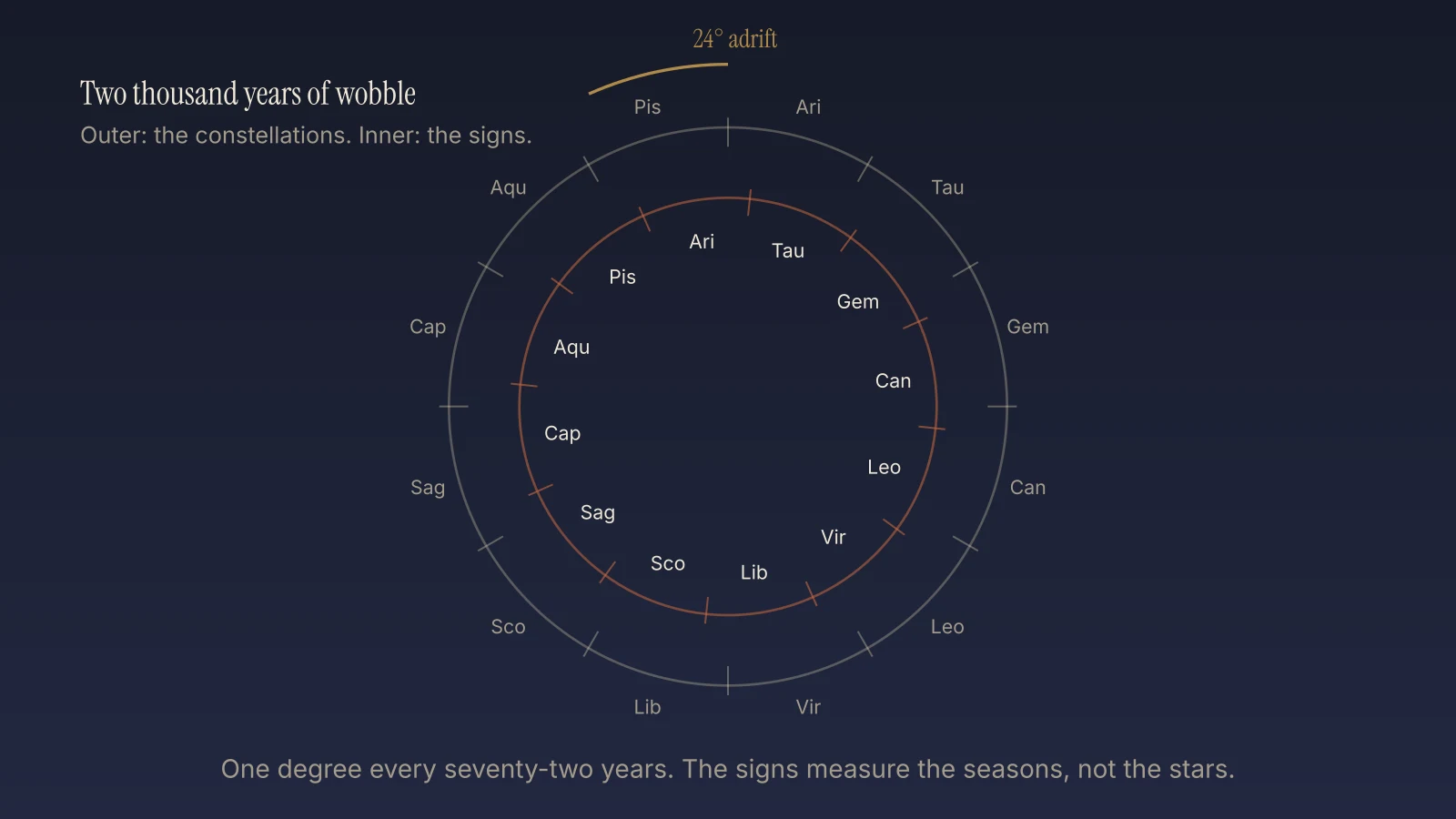
Because the zodiac most Western astrology uses is not a map of the constellations at all. It is a map of the seasons, divided into twelve equal thirty-degree slices starting at the March equinox, and it was named after the constellations that sat behind those slices around two thousand years ago. Since then the Earth has wobbled, the slices have slid, and they are now most of a sign out of step with the stars they are named for.
What is making it drift?
The Earth’s axis traces a slow circle, like a spinning top leaning and wobbling, taking about 25,800 years to come back round. That wobble is called the precession of the equinoxes. It moves the position of the March equinox backwards against the stars by roughly one degree every seventy-two years, which is about a full zodiac sign every 2,150 years.
Hipparchus noticed the drift in the second century BC by comparing his own star positions with records a century and a half older. It has been known about for the entire history of Western astrology; it is not something astronomers later caught astrologers out on.
The accumulated offset is currently around twenty-four degrees. So the tropical sign the Sun occupies on your birthday is usually a whole sign ahead of the constellation actually behind it.
So is the tropical zodiac just wrong?
It is answering a different question. Tropical astrology anchors to the seasons rather than to the stars: zero degrees Aries means the March equinox, wherever the stars have got to. On that definition nothing has drifted at all, because the definition was never about the constellations. It is a deliberate choice with a two-thousand-year argument behind it, not an error nobody noticed.
- Tropical
- Anchored to the equinox and the seasons. Standard in Western astrology, and what this site uses.
- Sidereal
- Anchored to the fixed stars, and so tracking the actual constellations. Standard in Indian astrology, which corrects for the drift with a value called the ayanamsa.
- The constellations themselves
- Unequal, overlapping, and thirteen of them touch the Sun’s path, including Ophiuchus. Neither zodiac uses them as they actually are.
The periodic news story announcing that "your star sign has changed" is really announcing that tropical and sidereal are different systems, which both traditions have known all along.
Where this is disputed
Which anchor is correct is a genuine and unresolved disagreement between two large living traditions, and there is no calculation that settles it. Sidereal astrologers regard tropical as having lost its connection to the sky; tropical astrologers regard the seasons as the thing that was always being measured.
Does knowing this ruin it?
Only if you believed the signs were about the physical stars, and they have not been for two millennia. What it does change is the kind of claim you can honestly make: the zodiac is a coordinate system, a way of dividing a circle so that positions can be recorded and compared. That is a modest and defensible description, and it is what a chart actually is.
It is also why the calculated half of astrology can be taken seriously on its own. Where the planets were, in whichever coordinate system, is a matter of record. The tradition built on top of that record is a separate question, and keeping the two apart is what lets you look at either one clearly.
OrbHeaven uses the tropical zodiac and says so, with the mean lunar node and Placidus houses, and the glossary names the places practitioners disagree instead of presenting one tradition as settled. Positions come from a modern ephemeris rather than from lookup tables.
About a minute. Birth time optional, and no account until after you have seen it.
Terms used here
Read next
Does Mercury actually move backwards?
No. Nothing reverses. Mercury only appears to loop backwards against the stars because we are watching it from a planet that is itself moving — and knowing why makes the whole thing less mysterious and more interesting.
What is a solar return, and why is it not always your birthday?
It is the moment each year when the Sun comes back to the exact degree it held when you were born. That moment lands about six hours later each year, which is why it can fall a day either side of the date on your certificate.
Why does every horoscope feel like it was written for someone else?
Because it was. A daily horoscope is written for a twelfth of the world at once. Here is what changes when a reading is calculated from your own birth details instead, and what honestly does not.
Written by Kevin Blaxton for OrbHeaven. About