How do you read a birth chart?
Kevin Blaxton · 12 min read ·
Read a birth chart in a fixed order. First check what was calculated, and how. Then find the Sun, Moon and rising sign. Then read each planet’s sign, degree and house, then the closest aspects, and finally the chart ruler. Every step has two parts that should never be confused: a position that is calculated, and a meaning the astrological tradition reads into it. The calculation can be checked. The reading is a reflective framework, not an established method of predicting events or of measuring personality. Open your chart beside this guide and work down it step by step.
What do you need before you start reading?
Three things, and one check. You need your birth date, the time to the minute, and the place. Then check the conventions your chart states: which zodiac it uses, which house system divides it, and how the birth time was converted to universal time. Two charts for the same birth can differ only because of these choices, so knowing them first saves confusion later. Without a birth time a chart can still be read, but less of it exists, as the last section explains.
Calculated: a birth chart is the sky seen from Earth at one moment and one place. Each planet’s position is measured along the ecliptic, the Sun’s apparent yearly path, as a sign and a degree. The time and place then set four points, the angles, and from them the twelve houses.
What to check: astrology has more than one convention at nearly every step. Most Western charts use the tropical zodiac, counted from the March equinox. The house system decides how the sky is divided into houses. And because time zones and daylight saving have changed over the years, a historical birth time has to be converted using the rules in force at that place and date.
On your OrbHeaven chart: the line at the very bottom names the engine and version, the tropical zodiac, the mean lunar node and the exact universal time the chart was cast for. Next to the Placements heading, the chart names its house system: Placidus. If the clocks repeated or skipped your birth time, the chart asks you which time you mean rather than guessing.
Where this is disputed
Sidereal astrology, used in the Indian tradition, measures the signs against the stars instead of the equinox, and its signs currently sit about 22 to 25 degrees away from tropical ones, depending on which sidereal system you ask. Neither is a calculation error; they measure from different starting points. See the tropical zodiac.
How is a chart wheel laid out?
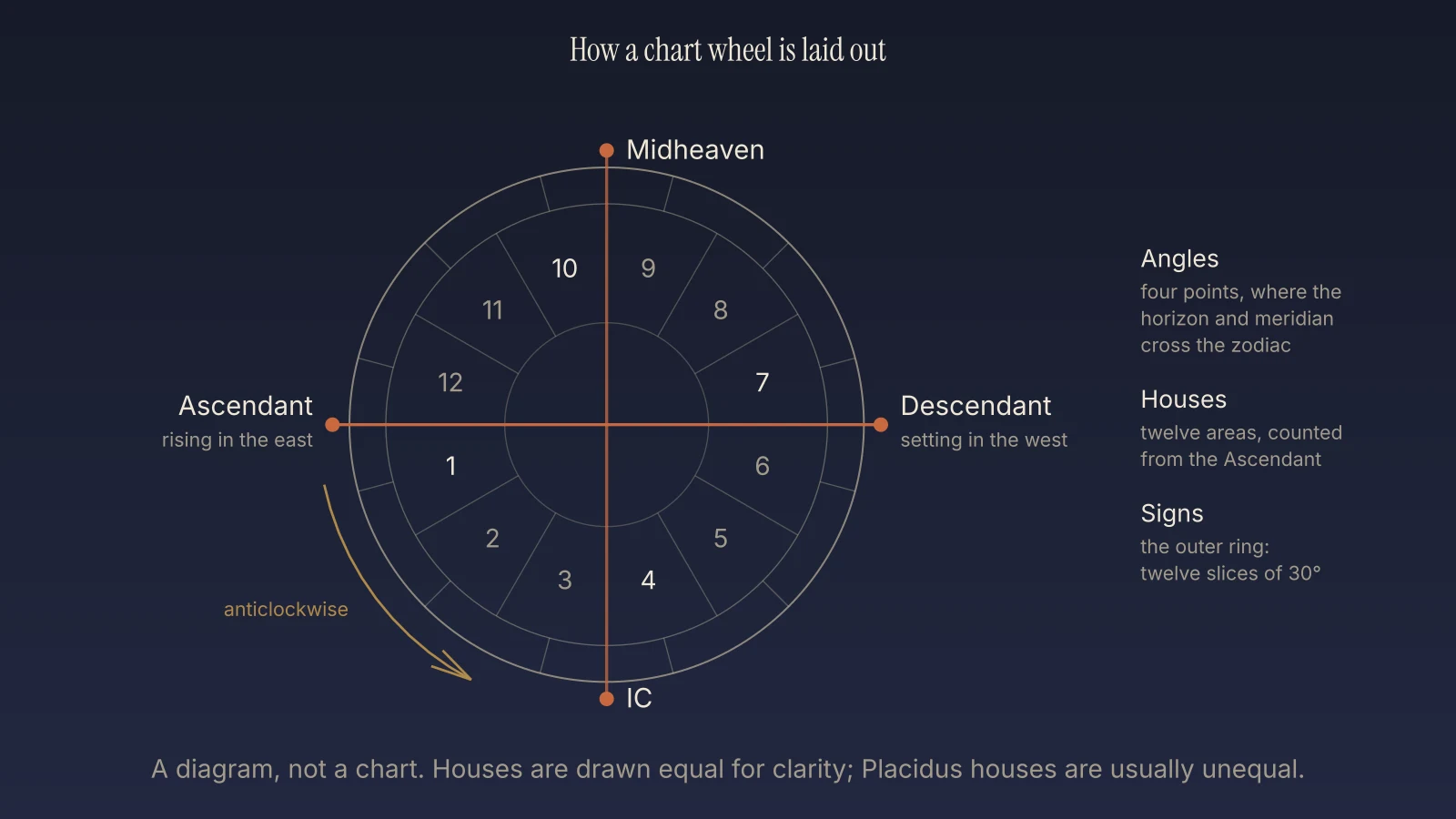
A chart wheel is a circle of 360 degrees divided into twelve signs of 30 degrees each. By convention the Ascendant, the point rising in the east, sits on the left, and the zodiac runs anticlockwise from it. Four points, called the angles, anchor the wheel: the Ascendant, the Midheaven near the top, the Descendant opposite the Ascendant, and the IC opposite the Midheaven. The twelve houses are counted anticlockwise from the Ascendant.
Calculated: the angles are points, not areas. The Ascendant is the degree of the zodiac rising over the eastern horizon. The Midheaven is where the zodiac crosses your meridian; it is rarely directly overhead. The Descendant and the IC sit exactly opposite these two. In the Placidus system each angle is also the cusp, or starting line, of a house: the Ascendant begins the 1st, the IC the 4th, the Descendant the 7th and the Midheaven the 10th. Those four are called the angular houses. The angles themselves are the four points.
Conventions you may meet elsewhere: many charts draw the planets as glyphs, small symbols such as a circle with a dot for the Sun, and connect planets with coloured aspect lines. Both are drawing conventions. The calculation underneath is the same.
On your OrbHeaven chart: the wheel follows the same orientation, Ascendant on the left. It labels each planet with two letters rather than a glyph, and draws no aspect lines: the aspects are listed in their own table instead, with each one’s measured angle. Without a birth time the wheel starts at 0° Aries on the left and has no houses, because there is no Ascendant to start from.
Step 1: Where are your Sun, Moon and rising sign?
Start with the Sun, the Moon and the Ascendant, also called the rising sign. Most astrologers begin with these three because they are read as the core of a chart. Find each one’s sign before anything else. The Sun’s sign usually follows from the birth date alone. The Moon moves about 12 to 15 degrees a day, so on some birth dates its sign depends on the birth time. The rising sign needs the exact time and place.
Calculated: the Sun moves about one degree a day. A new sign rises over the eastern horizon about every two hours on average, though unevenly, which is why the birth time decides the rising sign. In the example chart, J2000.0 (noon UTC on 1 January 2000 at Greenwich), the engine calculates the Sun at 10°22′ Capricorn, the Moon at 13°19′ Scorpio and the Ascendant at 24°15′ Aries.
How it is traditionally read: the tradition reads the Sun as what a person is building toward, the Moon as what they need to feel at home, and the rising sign as how they come across and the lens the rest of the chart is seen through. In the example, a Capricorn Sun, a Scorpio Moon and Aries rising would be read together as one picture, not three separate ones. See why astrologers start with these three.
On your OrbHeaven chart: the big three are the first thing on the page, above the wheel, each with its sign and degree. Every term links to its definition.
The example chart, calculated
Calculated with astronomy-engine 2.1.19 · tropical zodiac · mean lunar node · placidus houses
Step 2: What do a planet’s sign and degree tell you?
The sign is the 30-degree slice of the zodiac the planet was in. The degree is how far into that slice it was. A position written 10°22′ Capricorn means ten degrees and twenty-two minutes past the start of Capricorn, where a minute is a sixtieth of a degree. The degree matters less for meaning than for measurement: aspects and houses are worked out from it. Go down your planets one by one, reading the sign first and noting the degree.
Calculated: in the example chart, Mercury is at 1°53′ Capricorn, Venus at 1°33′ Sagittarius, Mars at 27°57′ Aquarius, Jupiter at 25°15′ Aries and Saturn at 10°23′ Taurus, retrograde. Retrograde is an apparent motion: seen from a moving Earth, a planet can look as if it is moving backward against the stars for a while. The planet itself does not reverse.
How it is traditionally read: a sign is read as a style. The planet says what is acting and the sign says how: the same Mars is read as pushing one way in Aries and quite another in Pisces. Read each planet as a pair: the planet describes what is being interpreted, while the sign describes how the tradition says it is expressed. See what the degrees mean.
On your OrbHeaven chart: the Placements table lists each planet with its sign, its degree to the minute, its house and whether it is direct or retrograde.
Step 3: Which house is each planet in, and why?
Houses are twelve divisions of the sky counted from the eastern horizon at the moment of birth, so they depend on the birth time and place rather than the date. Each planet falls in one house. Find the house for each planet, starting with the Sun and Moon. A planet’s sign says how it acts; its house is read as where in life it acts.
Calculated: Placidus, the most common modern system, divides the houses by time, so they are usually unequal in size. In the example chart’s Placidus houses, the 1st house begins at the Ascendant, 24°15′ Aries, and runs to 1°08′ Gemini, so all of Taurus falls inside it. The Sun, at 10°22′ Capricorn, sits just past the Midheaven at 9°36′ Capricorn, in the 10th house. The Moon is in the 7th, Jupiter and Saturn are both in the 1st, and Mars sits a quarter of a degree inside the 12th.
How it is traditionally read: the tradition reads the 1st house as the self, the 4th as home, the 7th as partnership and the 10th as work and standing in the world, with the rest filling in the spaces between. It gives the angular houses, the ones that begin at the four angles, more weight than the others. That weighting is a convention, not a measurement. See what houses are.
On your OrbHeaven chart: the house for each planet is in the Placements table, and the House cusps list shows where each house begins. If you were born very far north or south, where Placidus cannot be calculated, the chart switches to whole-sign houses and says so.
Where this is disputed
House systems disagree, and the disagreement moves real planets. In whole-sign houses, the oldest method, each house is one whole sign counted from the rising sign. In the example that puts the Moon in the 8th rather than the 7th, Saturn in the 2nd rather than the 1st, and Mars in the 11th rather than the 12th. Neither system is the arithmetic being wrong. See house systems and why astrology calculators give different results.
Step 4: Which aspects should you read first?
An aspect is the angle between two points in a chart, usually two planets. The main ones are 0° (conjunction), 60° (sextile), 90° (square), 120° (trine) and 180° (opposition), and many astrologers add 150° (quincunx). Planets are almost never at an exact angle, so an aspect counts within an allowed distance called the orb. Read the aspects with the smallest orbs first: the closer to exact, the more weight the tradition gives them.
Calculated: the distance from exact is measured; how wide an orb to allow is a convention. In the example chart the closest aspect is the Sun trine Saturn, 0.03° from exact. Then come the Sun conjunct the Midheaven at 0.76°, Saturn trine the Midheaven at 0.79° and Jupiter conjunct the Ascendant at 0.99°. The second and fourth are aspects to angles, the points, not to houses.
How it is traditionally read: the tradition reads squares and oppositions as friction that asks for effort, trines and sextiles as ease, and a conjunction as two planets working as one. An aspect between two planets is also read as applying, still tightening, or separating, already easing; see applying versus separating aspects.
On your OrbHeaven chart: the Aspects list sits below the placements, listed from the closest to exact. Each aspect gives its orb and, between two planets, whether it is applying or separating. The allowed orbs are 8° for conjunctions and oppositions, 7° for squares and trines, 5° for sextiles and 2.5° for quincunxes, with one degree more when the Sun or Moon is involved.
Where this is disputed
Astrologers set orbs differently, and some count minor aspects that others ignore, so two charts can list different aspects for the same birth. Many traditional astrologers also reject the simple split into hard and easy aspects, reading each through the planets involved instead. See orbs.
Step 5: What is the chart ruler, and where does the weight sit?
The chart ruler is the planet that rules your rising sign. The tradition reads it as the planet that steers the whole chart, so its sign, house and aspects are read with extra weight. Find your rising sign, find its ruling planet, then find where that planet sits. Then look for a stellium, three or more planets in one sign or one house: the place where a chart’s emphasis gathers.
Calculated: which planet rules which sign is a fixed table of tradition, not a calculation; where that planet sits is calculated. In the example, Aries rises and Mars rules Aries. Mars sits at 27°57′ Aquarius in the 12th house, a quarter of a degree from the cusp. Mars, Uranus and Neptune are all in Aquarius, which makes a stellium in that sign.
How it is traditionally read: the ruler’s sign is read as how a person goes about things, and its house as where their life tends to happen. A stellium is read as an area the rest of the chart keeps returning to. See the chart ruler and what a stellium is.
On your OrbHeaven chart: the Shape section, just below the wheel, names your chart ruler with its sign and house, and any stellium.
Where this is disputed
Modern astrologers often give Scorpio, Aquarius and Pisces to Pluto, Uranus and Neptune; traditional astrologers keep Mars, Saturn and Jupiter. Where your rising sign is one of those three, both rulers are shown.
How do you put the steps together?
Read each placement as one sentence: the planet is what, the sign is how, the house is where, and any close aspect is the relationship between two planets. Start with the Sun, Moon and rising sign. Add the chart ruler and the tightest aspects. Notice where they repeat a theme, and where they pull against each other. Write it down in plain language. Treat the result as a reading to think with, not as a fact the positions have established.
Worked through: in the example, a Capricorn Sun in the 10th, close to the Midheaven, with the tightest aspect in the chart a trine to Saturn. The tradition would read Capricorn, the 10th house and Saturn as saying the same thing three times. It would set that beside an Aries Ascendant with Jupiter on it, and a Scorpio Moon in the 7th.
What to keep separate: that paragraph is interpretation. Everything it rests on, the signs, degrees, houses and orbs, is calculated and can be checked. Keep the two apart as you read your own chart: you can trust the arithmetic and still disagree with the reading, and the reading is never evidence for itself.
What changes if you don’t know your birth time?
Without a birth time, a chart can still be worked out across the whole birth date, but less of it exists. The planets’ signs and approximate degrees remain, and many aspects can still be known. The Ascendant, Midheaven and houses cannot, because they depend on the minute, and with them go the rising sign and the chart ruler. A careful chart shows ranges and says what it cannot know, rather than guessing a time.
Calculated: without a time, the chart is worked out across every real moment of the birth date. Each planet shows the degrees it covered that day, or both signs if it changed sign. Aspects are marked certain when they held all day and possible when they depend on the hour. For the example date with no time, the Sun shows as 9–10° Capricorn and the Moon as 7–19° Scorpio, still one sign, though the Moon covered about twelve degrees that day. The Sun trine Saturn is certain; the Sun sextile Moon is only possible; and no planet has a house.
What changes in the steps: Step 1 keeps the Sun and Moon (both signs, if the Moon changed sign) but has no rising sign. Step 3 and the chart ruler in Step 5 drop out. In Step 4, read only the aspects marked certain as part of the chart.
On your OrbHeaven chart: tick “I do not know my birth time” and the chart shows exactly this: ranges, certain aspects listed before possible ones, a wheel starting at 0° Aries with no houses, and no rising sign guessed. See without a birth time.
The quickest way to learn this is to do it on your own chart. The free birth chart needs no account, and it does not save your chart or your birth details. It lays out the big three, the wheel, the placements, the houses and the aspects in the order this guide follows, with every term linked to its definition and the engine, zodiac and exact universal time printed at the foot.
About a minute. Birth time optional, and no account until after you have seen it.
Read next
Why do astrology calculators give different results?
Why two astrology calculators can give different charts for the same birth: house systems, zodiacs, the node, time zones, a missing birth time and orbs, each measured on one real example chart.
What is the difference between an applying and a separating aspect?
An applying aspect is still moving toward exact; a separating one has already passed it. Which is which is arithmetic rather than opinion, and it changes how the aspect is usually read. With a worked example you can check for yourself.
Does Mercury actually move backwards?
No. Nothing reverses. Mercury only appears to loop backwards against the stars because we are watching it from a planet that is itself moving — and knowing why makes the whole thing less mysterious and more interesting.
Written by Kevin Blaxton for OrbHeaven. About