Reference · History of ideas
What are the four elements in astrology?
Kevin Blaxton — software builder; astrology student for 40+ years · figures computed by the OrbHeaven engine
Published · Last revised
The four elements — fire, earth, air and water — are a traditional classification that sorts the twelve zodiac signs into four groups of three. Fire acts, earth builds, air thinks, water feels: it is a shorthand for temperament, inherited from ancient natural philosophy. The elements describe how the tradition reads the signs; they are not a physical substance the signs are made of.
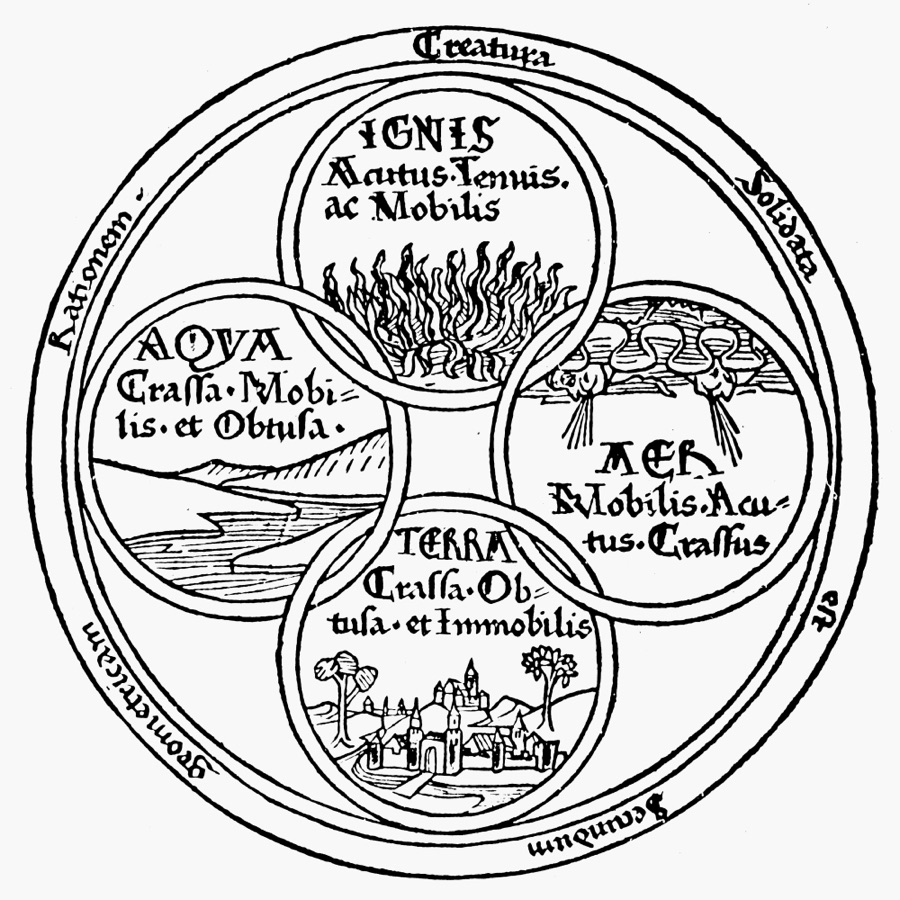
Source: Woodcut from Lucretius, De rerum natura (Brescia: Tommaso Ferrando, 1472) · historical diagram · public domain.
What are the four elements?
They are four groups the twelve signs are sorted into — fire, earth, air and water — three signs to each. The grouping is a classification of temperament the tradition uses to read a chart, not a claim that a sign is made of, or behaves like, the physical thing it is named for. A Leo is not hot, and a Pisces is not wet; the labels are a typology.
The quickest sketch many astrologers make of a chart is to count how many planets fall in each element — a chart heavy in fire read as driven, heavy in water as feeling. That is interpretation, and we keep it labelled as such.
The twelve signs by element
Each element holds three signs, and the three are spaced evenly around the zodiac — four signs, 120°, apart. The tradition gives each element two classical qualities (from the pairs hot/cold and wet/dry) and a temperament it lends to any planet placed in one of its signs.
- Fire — Aries, Leo, Sagittarius
- Classically hot and dry. Read as the active, spirited temperament: drive, warmth, confidence, a push outward.
- Earth — Taurus, Virgo, Capricorn
- Classically cold and dry. Read as the practical, grounded temperament: patience, substance, work, the material world.
- Air — Gemini, Libra, Aquarius
- Classically hot and wet. Read as the mental, social temperament: ideas, language, exchange, a step back for perspective.
- Water — Cancer, Scorpio, Pisces
- Classically cold and wet. Read as the feeling, receptive temperament: emotion, empathy, memory, depth.
Because an element’s three signs sit 120° apart, joining them draws an equilateral triangle on the wheel — which is why the tradition calls each group a triplicity, or trigon. The diagram shows all four.
How the elements relate to the signs and the modalities
The elements are one of two sortings laid on the same twelve signs. The four elements group the signs by temperament, three to each; the three modalities — cardinal, fixed, mutable — group them by how they move, four to each. Four elements times three modalities is exactly twelve, and every sign is a unique pairing of one element with one modality.
That makes an element a property of the sign, nothing more: OrbHeaven computes a body’s sign from its ecliptic longitude, and the element follows by lookup, with no further judgement. The wheel below colours each sign by element and marks its modality, so the whole grid is visible at once.
The signs themselves are equal 30° divisions measured from the March equinox — the tropical zodiac OrbHeaven uses — so which element a planet falls in is as fixed and public as the position itself. What that element is taken to mean is the tradition.
Where the four elements came from
From Greek natural philosophy, not from astrology. In the fifth century BCE Empedocles proposed that everything is made from four “roots” — fire, air, water and earth. Aristotle systematised them a century later, pairing two qualities (hot or cold, wet or dry) to define each, and this fourfold physics dominated Western thought for roughly two thousand years. Astrology inherited the scheme and applied it to the signs.
In that older picture the four elements were a genuine theory of matter — what the physical world was actually built from, and why things rose, fell, burned or flowed. Medicine ran on the parallel four humours; the whole scheme hung together as natural science of its day.
So the elements reached astrology already carrying centuries of meaning. The characters now attached to the signs owe as much to this philosophy as to anything in the sky.
They are not the elements of chemistry
Modern chemistry uses the word “element” for something entirely different: the roughly 118 substances of the periodic table — hydrogen, oxygen, iron — each a kind of atom. The classical four are not among them. Fire is not a substance at all but a process; air is a mixture; water is a compound; earth is countless materials. The fourfold theory of matter was superseded from the seventeenth century onward and is not part of modern science.
Keeping the two senses apart matters. The astrological elements are a traditional classification of the signs, of interest for what the tradition does with them; they make no claim about physics or chemistry, and nothing here should be read as one.
What the elements are read as
A working astrologer uses the elements as a first filter on a chart: the balance of fire, earth, air and water across the planets is read as the overall cast of a temperament, before any single placement is weighed. An element shades the style of any planet in its signs, the way the sign does.
Where this is disputed
How much weight to give an elemental “imbalance”, and whether to count all planets equally or weight the Sun, Moon and rising most, varies between practitioners and traditions. The groupings themselves are standard and old; the reading built on them is interpretation, kept separate from the astronomy.
Common misconceptions
- Are the astrological elements the same as chemical elements?
- No. Chemistry’s elements are the ~118 kinds of atom in the periodic table. The astrological four — fire, earth, air, water — are a classical classification of temperament applied to the signs, not substances and not part of modern science.
- Does a fire sign mean the person is literally hot or fiery?
- No. The element is a label for a style the tradition reads into the sign — active and spirited, in fire’s case. It is a typology, not a physical property of the sign or the person.
- Why are there exactly four elements and three signs in each?
- The four come from Greek natural philosophy (Empedocles and Aristotle), inherited by astrology. Twelve signs divide evenly into four groups of three, and each group’s signs fall 120° apart — the equilateral “trigons”.
References & further reading
- [1] Aristotle, On Generation and Corruption — the four elements defined by the paired qualities hot/cold and wet/dry.
- [2] Kingsley, P., Ancient Philosophy, Mystery, and Magic: Empedocles and Pythagorean Tradition — Empedocles’ four “roots”.
- [3] Tester, S. J., A History of Western Astrology — the elements, qualities and temperaments in the astrological tradition.
- [4] IUPAC, Periodic Table of the Elements — the modern chemical elements, distinct from the classical four.
Suggested citation
Blaxton, K. (2026). What are the four elements in astrology. OrbHeaven Reference. https://orbheaven.com/reference/the-four-elementsRevision history
- First build. Original “four elemental trigons” diagram (standard triplicity groupings) plus the reused signs wheel for the element × modality grid; cross-links The Zodiac Signs and The Tropical Zodiac. History section separates ancient natural philosophy from modern chemistry. Imagery: a 1472 woodcut of the four elements from Lucretius’ De rerum natura (public domain, labelled historical-diagram) as the hero; no NASA photography (none apt). No interactive (reuses figures).
Related glossary entries
About a minute. Birth time optional, and no account until after you have seen it.
More in the reference library
What are the twelve signs of the zodiac?
The twelve signs are equal 30° slices of the ecliptic, sorted by four elements and three modalities. This explains the structure, how a sign is determined, why the signs are not the constellations they are named for, and what the tradition reads into them.
What is the tropical zodiac, and why are the signs not the constellations?
The tropical zodiac measures the signs from the March equinox, not from the stars — which is why, after millennia of precession, the signs no longer line up with their constellations. With engine-computed tropical/sidereal/constellation comparisons.
What is a birth chart, and how is one built?
A birth chart is a map of the sky at the moment and place you were born. This explains how one is assembled — the frame, the signs, the planets, the houses and aspects — reusing OrbHeaven’s engine, and where calculation ends and interpretation begins.