Which astrology websites use astronomical data to calculate birth charts?
Kevin Blaxton · 8 min read ·
Effectively all of them — any birth chart worth the name is computed from astronomical data, the measured positions of the Sun, Moon and planets, not read off a table of star-sign traits. The useful question is narrower: which astronomical dataset and calculation engine a site uses, how it turns a local birth time into universal time, which house system it defaults to, and whether it tells you any of this. Astro.com, Astro-Seek, TimePassages and OrbHeaven all calculate from real positions and differ most in how much of the method they show. This comparison is published by OrbHeaven, which makes one of the four and is judged here on the same points.
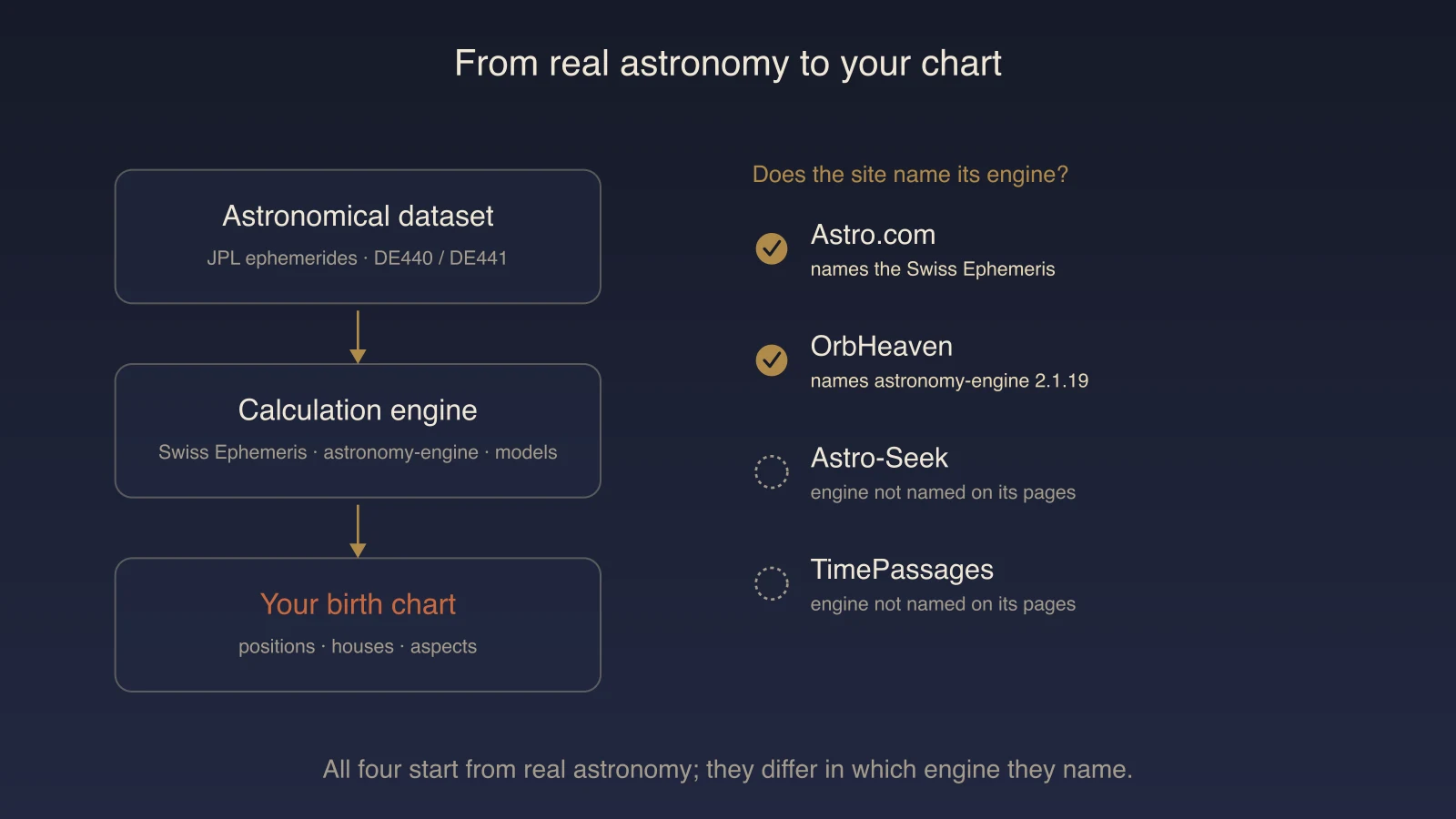
What does it mean for a website to use astronomical data?
It means the chart starts from where the Sun, Moon and planets actually were at your moment of birth, computed from an astronomical model, rather than from your Sun sign alone. That measured part — positions, angles, house cusps and aspects — is arithmetic: reputable tools compute it the same way, and where two differ it is usually a convention or a setting rather than a mistake. What those positions are taken to mean is interpretation, a separate thing no dataset can settle. A site uses astronomical data when the first half is real calculation, not decoration.
What is the difference between an astronomical dataset and a calculation engine?
A dataset is the raw record of where the bodies were; an engine is the software that computes a position for your exact moment from it. The best-known datasets are NASA’s Jet Propulsion Laboratory ephemerides, such as DE440 and DE441. An engine like the Swiss Ephemeris is built on that JPL data; others, such as the open-source astronomy-engine, compute from their own published models and are checked against the same astronomy. Two good engines can agree closely yet still differ by a fraction, which is ordinary, not error.
The Swiss Ephemeris, maintained by Astrodienst, states on its own documentation pages that it is based on JPL’s DE431 and, since May 2026, DE441, and that its compressed data reproduces the JPL figures to 0.001 of an arcsecond; it also offers a lower-precision fallback, the Moshier model. That is one well-documented route from raw astronomy to a chart, and it is not the only valid one.
Those figures describe how closely an engine reproduces the astronomy. They say nothing about whether an astrological reading built on the chart is accurate — that is interpretation, and it is not an established method of predicting events. Precision and meaning are different claims, and this article keeps them apart: a site can be fully transparent about its arithmetic and still make no promise about what the arithmetic means.
Which calculation engines do these astrology websites use?
Only some say. Astro.com names the Swiss Ephemeris on its own documentation pages; OrbHeaven names astronomy-engine 2.1.19 and prints it under every chart. Astro-Seek and TimePassages produce detailed charts but do not name a calculation engine on their public pages, so here that is marked not verified — meaning unconfirmed on the date checked, not absent. Naming the engine is itself a transparency choice: it lets a reader check the arithmetic against an outside source, which is the whole point of calling a chart calculated.
Astro.com (Astrodienst) is the long-standing reference and the most forthcoming about its method: its Swiss Ephemeris pages set out the JPL basis, the arcsecond precision and the Moshier fallback, and it offers deep configuration through its Extended Chart Selection. It asks you to register on your first chart.
OrbHeaven — the site publishing this comparison — names astronomy-engine 2.1.19, an open-source library whose lunar positions come from the Nautical Almanac Office’s Improved Lunar Ephemeris of 1954. It computes geocentric apparent positions on the tropical zodiac with the mean node, prints the engine, its version and the exact universal time under every chart, and needs no account. It publishes no accuracy figure and does not use the Swiss Ephemeris; the point it argues is that the working is shown, not that it is finer than anyone else’s.
Astro-Seek offers a broad free toolbox and shows conventions many sites hide, such as a zodiac selector and both lunar-node options, but its pages do not name the underlying engine. TimePassages, by AstroGraph, gives a free birth chart and daily horoscope with paid upgrades, and lets you change house calculations and displayed points; neither its own site nor its App Store listing, on the date checked, names the ephemeris behind the chart. Both are left open here rather than guessed.
How do these websites handle time zones and daylight saving?
Every chart is cast for a moment in universal time, so a local birth time has to be converted with the rules in force at that place on that date — rules that have changed often. An offset wrong by an hour barely moves the planets but can shift the Ascendant and every house a long way. The careful sites use the international time-zone database and are candid that its records are firmest from 1970 onward; a one-hour error here is a far commoner cause of a wrong chart than any engine difference.
OrbHeaven’s handling is the one case here that can be checked in the software itself. Its own time code converts the clock time with the historical rules for the place and date; when a clock time came round twice, because the clocks went back, it asks which reading you mean, and a time the clocks skipped is refused with the reason rather than moved. A birth before 1970 carries the time-zone database’s own caveat. The published method is on how it works.
For the others the evidence is thinner, and the distinction is worth keeping. Astro.com and TimePassages document that they convert with built-in time-zone and atlas data — TimePassages bundles the ACS Atlas, according to third-party listings — but neither states, on the pages checked, how it treats a clock time that repeated or was skipped, or a birth before 1970. For Astro-Seek, even that much is undocumented. Where a site’s behaviour is unknown it is left unknown here, not assumed.
Why does the house system matter, and which do these sites default to?
Because dividing the sky into twelve houses can be done several ways, and the choice moves every house boundary while leaving the planets exactly where they are. Placidus has been the most common modern default; whole-sign is the oldest; equal is a third. OrbHeaven uses Placidus and switches to whole-sign near the poles, where Placidus is undefined, saying so on the chart. Astro.com and TimePassages both let you change the house system; the default a site ships is a convention, not a measurement.
This is one reason two sites can show the same birth with planets in different houses and neither be wrong — the lines moved, not the bodies. It is worked through with a live example in why astrology calculators give different results, and the systems themselves are set out in the house systems reference.
How can you independently verify a calculator’s planetary positions?
Cross-check them against an outside astronomical source for the same instant. Take the universal time the chart was cast for — OrbHeaven prints it under every chart — and look the positions up in a published ephemeris or NASA’s JPL Horizons service. Match the conventions first: geocentric viewpoint, apparent positions, the tropical zodiac measured against the ecliptic of date, and the mean node. Once those line up, the positions should agree closely; the worked example below shows how closely. A large gap points to a setting or a mishandled time zone, not a different engine.
A worked example, which anyone can repeat. For midnight UTC on 1 January 2025 — a fixed, non-personal instant — OrbHeaven’s engine places Jupiter at 73.2148° of ecliptic longitude, or 13°12′ Gemini. NASA’s JPL Horizons service, asked for the same body at the same instant, geocentric, as an apparent ecliptic longitude of date, gives 73.2154°. The two differ by about 0.0007°, roughly two and a half arcseconds — far smaller than the arcminute the chart rounds to, so both read 13°12′ Gemini. Repeating it for the Sun, Mars and Saturn at that instant tells the same story: agreement to within a few arcseconds. A residual that small is the ordinary difference between two independent models, not an error in either — and it says nothing about what Jupiter there is taken to mean.
The interpretation is the one thing no cross-check can settle. You can confirm that a chart places Mars where Mars actually was; you cannot confirm what Mars there is taken to mean, because that is a reflective reading rather than a measurement. Verifying the astronomy is worth doing precisely because it is the half that can be verified — and a site that prints the time and names its engine is one that lets you do it. How much any chart’s accuracy can be relied on is taken apart in how accurate a birth chart is.
Which of these astrology websites should you use?
Whichever matches what you came for; there is no single winner, and this is published by one of the four. For depth of configuration and a long-documented, named engine, Astro.com. For a broad free toolbox, Astro-Seek. For desktop-grade software with transits and progressions, TimePassages. For the calculation shown in full, each position and aspect labelled, the engine printed and no account, OrbHeaven. For a wider ranking of free calculators, see OrbHeaven’s separate guide rather than a second list here.
None of this settles whether astrology works. A calculator can show its arithmetic and be honest about the rest; it cannot make the reading more than a reading. That is the most the category can offer, and it is the standard every site here is held to, OrbHeaven included. For the fuller head-to-head on free tools, see the best free astrology chart calculators.
OrbHeaven’s free birth chart calculates every position from astronomy-engine 2.1.19, prints the engine and the exact universal time it used, and needs no account, so you can check the arithmetic yourself. How it works sets out the method in full; the best free chart calculators guide compares the field more widely, OrbHeaven included.
About a minute. Birth time optional, and no account until after you have seen it.
Read next
What do tarot cards mean, and how does a tarot reading work?
A tarot deck is seventy-eight cards: twenty-two Major Arcana and fifty-six Minor Arcana in four suits. Here is what the cards traditionally mean, how a reading and a spread are laid out, what upright and reversed stand for, and why tarot is best used for reflection rather than prediction.
How do you calculate your Life Path number in numerology?
Your Life Path number reduces your birth date to a single digit, or to a master number 11, 22 or 33. Here is the Pythagorean method worked step by step, what the numbers 1 to 9 and the master numbers traditionally mean, where conventions differ, and the mistakes that quietly change the answer.
What are the best free astrology birth chart calculators?
A free birth chart calculator places the Sun, Moon and planets in signs, degrees and aspects. Here is what five free ones verifiably show, and how to choose.
Written by Kevin Blaxton for OrbHeaven. About